
Can we ever change who we are

As a psychiatrist and novelist concerned with people’s inner conflicts, I’m often asked whether people can truly change.

The answer is: yes, and no.

Most mental health professionals agree that our deeply embedded traits and tendencies are ingrained by the time we’re adolescents. Yes, there can be some minor modifications after that, but our basic way of interacting with others is pretty much set by the time we’re 17 or 18. We interact with others in a fairly inflexible and deep-rooted manner. It’s our “way of being.”

So what about someone seeking psychotherapy because of unhappiness with relationships and how life is going? What about the person who repeats endlessly the same maladaptive patterns of behavior leading to frustration, failure, unhappiness, and even depression? Or the person whose relationships are tainted by neediness, or dependency, or the wish to dominate others; or any other traits that make for problems interacting with people?

You’ll notice these aren’t symptoms such as a phobia, or panic episodes, or an onset of a symptom causing psychic distress. Rather, these are enduring personality traits, not temporary states of being.

The goal of any psychotherapy is to help a person develop a better understanding of one’s self. It’s called insight. Hopefully, by developing an awareness of personality flaws, a person can recognize them, and nip them in the bud before they exert themselves and ruin relationships. If this can be accomplished, the person may experience less conflict or tension with other people, and lead a more fulfilling life.

For example, a man comes for counseling because he’s been fired from three different jobs. During sessions (to which he always arrives late), he realizes that as far back as elementary school, he undermined his own success by tardiness and by not completing tasks on time. In high school, he received Cs instead of As because he never submitted his work by the stated deadline. In business, he repeated the same pattern.

He also learns in the psychotherapy sessions that as a child, being late or dawdling was a way to get much-coveted attention from his parents. Without realizing it, throughout his adult life, he’s been repeating this pattern with every authority figure. This has been the source of conflict, failure, firings and general unhappiness throughout his adult life.

With awareness of this tendency, he can begin working to change this maladaptive and self-destructive behavioral pattern — this deeply ingrained trait. He may not always be successful in this effort, but some positive and adaptive changes in his behavior can occur.

While his trait may not have been eradicated, his behavior and interactions with others can begin to change for the better.

I like to think of it in this simple way: Imagine personality style as a 90-degree angle. If a person can move that angle a mere three degrees, then a significant change in how one interacts with other people is surely possible. This can lead to positive changes.

So once again, can people change their basic personality patterns?

Yes, and no. While they don’t alter their basic personalities, through insight, they can change their behavior and become more skillful in their interactions.

© Mark Rubinstein, M.D.
Posted in News & updates | Leave a comment

5 More Ways of Coping with Panic

Awhile back I listed some symptoms of panic and a few techniques that have helped me cope (as well as these exercises for managing anxiety).

These techniques work for me whether I am in the midst of a full-blown panic attack or experiencing some fleeting anxiety. Here are five more ways I deal with my worrying brain.

1. Unravel the worry web.

Panic and anxiety are successful at raising our heart rate because, while we are in that state, a small kernel of a worry is miraculously transformed into a massive web of worries. That takes a bit of sweat and energy. So we have to work equally as hard at unraveling the web of worries back into the kernel or kernels we started with.

Some webs:  “This is the end of the world.” “This is the end of my career.” “This is the end of me.” Try to unravel those webs into three sub-worries, such as “My boss hates me.” “The company is tanking.” “I’m going to get fired.” Then break down each of those into three more, such as: “I’m not performing at work,” “blah blah frightening blah.” Finally, you might arrive at some kernels (based on “This is the end of my career”) such as, “My last press release stunk and my boss was disappointed,” and “My resume is not updated.” Even if your kernel is substantial, like “I need a new job, but I’m scared to get one,” that’s still better that sweating over a generalized statement like, “My career is over.” Even if it is.

 2. Don’t engage.

When one of my kids is throwing a tantrum, the worst thing I can do, which I consistently do, is yell at them. Why? I give him the attention he is seeking. What really drives him crazy? When I don’t engage at all. Or (this is the worst) walk out of the room.

Our worrying brain in the midst of a panic attack is like a kid throwing a colossal tantrum. Give in to it, and the brain wins. Blow it off, the old noggin might forget about what it’s so upset about. This theory is grounded in neuroscience. A study published in Journal of Neuroscience showed that there is a breakdown in normal patterns of emotional processing that can prevent anxious people from suppressing negative emotions. In fact, the more they tried, the more they activated the fear center of their brain, the amygdala, which fed them more negative messages.

3. Rewrite the formula.

“You are equipped to handle this! You go, girl!”

According to Tamar Chansky, Ph.D., founder and director of the Children’s and Adult Center for OCD and Anxiety, the anxiety formula goes like this: Overestimation of threat + underestimation of ability to cope = anxious response.

My exercise of unraveling the worry web aims to break down the threat into pieces that can be addressed and managed. Underestimating the ability to cope is another animal altogether. I have never been able to say confidently, “Self, you are equipped to handle this! You go, girl!” I need to pretend I am talking to a friend.

Psychiatrist and bestselling author David Burns, M.D., calls this “the double standard technique:” you address yourself with the same compassion as you would someone you like and respect. With those two pieces in place, you can begin to build a more realistic response to the panic.

4. Indulge the anxiety.

You’ve tried to break it down. You’ve tried your best not to engage. You’ve tried to rewrite the formula. You’re still stuck. Go ahead and obsess, then.

That’s right. Throw away the self-help books and give the power back to your anxiety. Invite all those bad stress hormones back into your bloodstream and indulge in panic for five or 10 minutes before trying all the other exercises again.

In a famous psychological study from the 1980s, a group of people were told to think about anything but a white bear. Guess what they all thought about? A white bear. So sometimes by trying so hard not to panic, we panic more. Give your brain a break now and then.

 5. Get used to it.

Chansky describes the process of graduated exposure and systematic desensitization, a cognitive-behavioral therapy term, as this: “get used to it” (GUDI). That’s the response a number of kids gave her when she asked how they got over their fears. They said they “got used to it.”

Sometimes panic is just about doing something over and over until it gets easier. When I began writing full-time, I became paralyzed every time I sat down at my computer. I spent about 80 percent of my working hours in panic, sometimes shaking and crying at my keyboard. A month later, having forced myself to churn out material practically every day, I am much less anxious. I simply have had to get used to it.

Originally posted on Sanity Break at Everyday Health.

Posted in News & updates | Leave a comment

My Life with Anxiety

Since I was younger, I knew that I thought in a different way than most children. As I grew older, I became consumed with death and its aftermath. I couldn’t understand why my biggest worry wasn’t which dress I would wear to prom. I felt like a fish out of water, and no one would understand.

After seeking help, I grew to realize that living with anxiety is not so abnormal. Some people have low cholesterol, some are allergic to peanuts, and some, like me, have an anxious mind. Honestly, I would pick anxiety over a peanut allergy any day.

In the beginning of my treatment, I felt alone and misunderstood. I refused to talk to my parents about what I was going through because I was convinced that they would not understand. While I was learning to cope with my anxiety and irrational fears, I thought about how many other teenagers shared the same thoughts as me. I felt like I wanted to let others know that they are not alone in what they are going through.

I’m not a therapist, a doctor, a social worker, or anything of the sort. I am, however, a daughter, sister, and a friend. Some may even call me an analyst. I take things in and let it marinate until I can understand the world. I learned enough from my experiences, and I continue to learn every day. And maybe I’ve even suffered a little. But mostly, I am a self-motivator. And since I’ve learned so much, from myself, and those around me, including family and friends, I feel inclined to share my knowledge with the world. After everything that I went through, I wanted to help others learn what I have learned, and show people how to look inside themselves without fear. I wanted to show people how to figure out who they are, and understand how to come to terms with it.

I grew up in a nice Jewish home with my family. I have great parents, and both a younger brother and sister. I went to private schools, summer camps, family vacations, I had food on my plate, and my room was painted in my favorite color. How could I complain? I was always a happy child. I had an amazing childhood. On the outside I looked like any other normal American girl. I had playdates, I did well in school, I had a loving family, and I had the ultimate collection of Barbie dolls. And just like a Barbie, I knew how to show my plastered smile and dress to impress. Nobody ever knew what was actually going on inside of me, and how my thoughts and fears ate me up alive. I knew how to hide my emotions, at least the ones I didn’t want anyone to see.

I still lived my life like any other ordinary child. I grew up with fears, but every child did too, so I didn’t think it was anything abnormal per se. But every year, kids grow up a little more. They become more mature. I grew up in a different way. Yes, I got taller, I went through puberty, and I even matured. But most kids’ fear of having a monster under the bed eventually goes away, and they even stop sleeping with a nightlight. My childhood fears followed me into young adulthood, but instead of a monster, my fears became more intensified and more about me. By the time I was 5, I stopped sleeping with a nightlight. I slept through the night and I didn’t worry about the monsters under my bed.

When I was 16, I studied abroad. I lived with three other roommates and everything was great. When I returned home, I started sleeping with the light on. Every night I slept with the light on until I was 19. It was embarrassing, and a secret I’ve kept until now. Before I sought treatment for my anxiety, I didn’t think there was anything wrong with me. Even though I slept with the light on, I didn’t think that I needed to see a therapist or seek any type of help. It wasn’t until my first panicattack that I realized that I have major anxiety.

I was drowning in the most irrational fears and obsessions that made me feel like I could never have a normal future. Because of all of my anxieties, I was convinced that I was mentally ill, and that I needed to be institutionalized. I was afraid of death, and a loss of control, but at the same time, I also struggled to find a purpose for my life. My anxiety took over my life for a long time, until I stopped letting it.

My battle against my anxiety isn’t over yet, but I’ve come a long way already. Seeking help saved my life, and I am grateful for all of the support I received. Things got easier over time, but it was the will to make my life better that got me through my toughest moments. Anxiety disorder does not mean you’re crazy. It’s perfectly fine to need extra support. You’re not alone.

KatyaShut/Bigstock

Posted in News & updates | Leave a comment

The Denial of Trauma

“I don’t have trauma.”“What happened to me isn’t trauma.”

“Trauma is something horrific.”

“I should have been able to cope with it.”

“It’s not sad.”

“I’m not upset.”

Accepting you are suffering from trauma is by far one of the most difficult aspects of recovery. I thought that admitting I was suffering from trauma suggested I couldn’t cope with the events in my life or I didn’t have the strength to deal with and process those events. I thought (and sometimes in my dark moments still think) that suffering from the effects of trauma made me weak, broken and a failure. I have met many other people who share this sentiment. They are stuck in a cycle of denial which keeps them prisoner in a cage of negative behavior patterns and harmful symptoms.

Admitting you are suffering is not only difficult for you, but has an impact on everyone in your life, in particular your family. Others around you may not want you to be suffering from trauma as it makes some difficult truths real.

Admitting trauma means other people have to look at themselves. The denial of trauma absolves everyone of their own feelings. Having the strength to say, actually, you know what, this happened and this has contributed to where I am today, is the hardest thing many sufferers will have to do in their lives. Having the strength to say this trauma is mine and I am owning my feelings will mean others have to step back and own their own feelings. Refusing to hold other people’s reactions as my own has been, and still is, nearly impossible. Often you will go against the opinion of nearly everyone closest to you.

Admitting you are suffering does not mean you are blaming anyone. Trauma’s reality does not mean someone must be responsible. The nature of getting better is to look internally and to accept that trauma is a subjective experience as opposed to objective facts of what happened.

So what is trauma? Why are some events considered traumatic to some and not others? Why did this event affect one person and yet have no impact on another? Why do people find trauma so hard to accept? I believe it’s because it is an unspoken topic. There is no narrative for trauma.

The psychological definition of trauma is “damage to the psyche that occurs as a result of a distressing event or an overwhelming amount of stress that exceeds the ability of the individual to cope and integrate the emotions involved.” This definition often gets simplified into the dictionary definition of “a deeply disturbing or distressing event,” which is where we all get a little lost. It’s very easy to understand trauma as something horrific, like war, or mass violence, or a natural disaster. It’s the “exceeding ability to cope and integrate emotions” section that gets lost on us.

We need to get rid of the view that trauma is an action (an event). The more psychology tells us about trauma, the more it becomes clear that trauma is a reaction. Most importantly, it is an individual reaction.

My therapist is always telling me that some children are born more sensitive than others. The word “sensitive” always irritates me, so we have decided to agree that some children are born more emotionally intelligent than others. They are more in tune to others’ emotions and more able to connect and empathize with others’ feelings.

These children are the ones most susceptible to trauma. Combined with the lack of protective factors such as the ability or willingness to ask for help and inbuilt resilience characteristics, the possibility of trauma already seems higher. Trauma can happen to anyone. It does not discriminate.

The view through trauma-tinted lenses is one of constant fear. It makes the world seem a frightening and dangerous place where no one can be trusted. Trauma leaves people feeling confused and insecure. Many children carry these tinted lenses into adulthood and this is when signs of post-traumatic stress disorder become apparent.

These normal reactions to abnormal events in childhood provided a function while the world was inherently dangerous. However, in adulthood these reactions become abnormal and become a hindrance to the ability to live, love and be loved.

digitalista/Bigstock

Posted in News & updates | Leave a comment

Is It Withdrawal Symptoms or a Depression Relapse

Four years ago, a good friend of mine put her 10-year-old son on Prozac (fluoxetine). He had always suffered from anxiety and anger outbursts, but at age 9, his behavior turned violent, and his ruminations were keeping him up at night. My friend and her husband went to a variety of child psychologists, but the cognitive behavioral therapy wasn’t enough. Finally, they got a referral to a psychiatrist, who diagnosed the boy with attention deficit hyperactivity disorder (ADHD), obsessive compulsive disorder (OCD), and generalized anxiety disorder (GAD). The doctor prescribed both Ritalin (methylphenidate) and Prozac.

The boy’s behavior was much better initially, but the drugs presented other problems: His weight dropped, and he stopped growing. Once a kid who was born with a healthy appetite and would try any food, such as chicken curry at age 1, his parents now couldn’t get him to eat anything. He went from being in the back row of his basketball photos, where the tall kids line up, to the front line, where the short kids kneel. And after six months, his old behavior returned.

The parents weaned him off the Ritalin, and the boy’s appetite returned. They tried to get him to eliminate gluten and sugar as much as possible, and have him load up on protein. They began giving him fish oil supplements, a multivitamin, and a probiotic. The dietary changes had a substantial impact on his behavior.

A few months later, they decided to try to taper him off the Prozac. He did fine initially, and the parents thought they were home free. But two months after he was off the Prozac, their son’s worrisome behavior returned — and it was worse than ever. My friend thought that they should take him back to the psychiatrist, but her husband disagreed. He had researched the half-life of Prozac and other withdrawal stories, and told her that many people go through a delayed withdrawal two to three months after taking the last pill. Unfortunately, he said, they would have to tolerate the bad behavior for a few months until the synapses in his brain made the adjustments.

The husband was right. The boy had two-and-a-half rough months, but he pulled through. Today he is eating, growing, and thriving — managing his anxiety some days better than others.

I remembered her story because I recently tapered off of one of my antidepressants. A month off, I was doing fine when all of a sudden I was hit with some acute anxiety. I wondered, “could it be a delayed withdrawal symptom?” I brought this up to my fellow depression warriors on Group Beyond Blue and ProjectBeyondBlue.com, and received confirmation: When you have tapered off an antidepressant, it is incredibly difficult to know whether you are relapsing into a depression, or if you are merely experiencing withdrawal symptoms that will go away in a few weeks or months.

My friend Margarita Tartakovsy interviewed Ross Baldessarini, MD, professor of psychiatry and neuroscience at Harvard Medical School, and director of the psychopharmacology program at McLean Hospital, for an article on Psych Centraldistinguishing withdrawal symptoms from depression. Dr. Baldessarini believes that when the depression re-emerges quickly, it’s easier to identify as withdrawal. If it happens weeks to months after discontinuation, then he thinks there is much more risk of its being a relapse.

But after weighing in with several of the members on both forums, I’m not so sure I agree with Baldessarini.

For example, one woman went off her antidepressant in March, and got really depressed and anxious in July. Her doctor said this is to be expected and is not unusual at all — that it’s a natural part of the brain’s readjusting process. According to her doctor, it takes a few months for the brain to realize something is missing, and to start the readjusting. The whole process can last six months to a year.

That makes a lot of sense to me. There are so many organic changes going on in the gray matter of your brain when you stop taking an antidepressant. For people like me who have a significant response to a teaspoon of sugar or three bites of pumpkin pie, think about the mayhem that’s going on inside the limbic system of my brain as it tries to reorganize all the synapses after it’s no longer getting a hefty dose of a powerful psychotropic drug. Although I don’t believe most classifications of antidepressants to be addictive — unlike benzodiazepines — I do believe your brain becomes dependent on them, so that it needs to relearn how to ride the bike again without training wheels when you go off them. Lots of skinned knees…

Of course, the withdrawal process is different for everyone. Much has to do with how long a person has been taking the medication, and at what dose. Obviously, someone who was taking 60 milligrams (mg) of Prozac for 20 years might need to wean much more slowly and endure many more withdrawal symptoms (and for much longer) than a person who was taking 10 mgs for a few months.

For some, the withdrawal symptoms are very distinct from the symptoms that they were experiencing before. They might resemble that of the flu: headaches, dizziness, nausea, or fatigue. In fact, Baldessarini discusses the “SSRI Discontinuation Syndrome” in his interview with Margarita that occurs in 20 percent of people who withdraw from antidepressants. A person may become agitated and angry more than depressed (if he or she was depressed before), or sad and lethargic more than anxious (if he or she was primarily anxious before). If a person is suddenly having crying spells after going off a medication that treated her anxiety and insomnia, chances are she is experiencing withdrawal symptoms rather than a relapse of her condition.

After reading dozens of articles on typical withdrawal times, and corresponding with dozens of folks, it seems as though three months is the average recommended time (and this begins once you start having symptoms, which could be two months after you’ve weaned off your drug) to wait to see if the symptoms clear up.

Jim Kelly, a member of my forum and a mental health advocate and speaker living in Westchester, Illinois, never agrees to a medication change without a transition plan.

“Changing medications, either starting or ending, cannot be fully assessed until two or three months in; that’s for me,” Kelly says. “And I always request some transitional medication in a small dose to ease side effects.”

Kelly has learned to be patient with the ugly process.

‪”I’m undergoing a change right now, and two weeks in I feel terrible,” he explains. “It feels like withdrawal from the old, rather than anything to do with the new…yet. I wish the two or three months would go faster, but it is what it is.”

Ultimately, I think you know yourself better than anyone and can tease apart the difference between withdrawal or relapse more easily than you think you can. After comparing my symptoms this week to the symptoms of depression I’ve had for so much of my life (for this reason, it’s important to keep a mood journal!), and assessing other things going on in my life (different diet, changes in schedule, etc.), I could recognize it was my brain just readjusting to a different chemistry, and that I’m on the right track.

Much like my friend’s son.

Posted in News & updates | Leave a comment

Words of Hope for Anyone Struggling with Depression

One of the worst parts about depression — and there are certainly many — is that it robs you of hope. Hope that you’ll actually feel better. Hope that the darkness will lift. Hope that the emptiness will fill up and you’ll feel motivated and excited. Hope that it won’t be like this forever. Hope that you’ll get through it.

“I’ve been struggling with depression for almost 35 years,” said Douglas Cootey, who pens the award-winning blog A Splintered Mind. “In that time, I have often felt hopeless, usually during times of suicidal ideation…Depression has a way of warping our outlook so that we only notice the bleakest parts of the world.”

The darkness stops feeling like a lens that distorts your reality, and starts to become your reality, said John A. Lundin, Psy.D, a psychologist who specializes in treating depression and anxiety in adults, teens and children in San Francisco and Oakland, Calif.

“Depression often robs you of the memory of joy or happiness, so it becomes difficult to draw on happy memories to give one hope for the future,” Lundin said. Depression even makes hope seem foolish, like an illusion, he said.

Many people with depression aren’t able to articulate that they feel hopeless. Because doing so requires putting “words to an experience that just feels as real and encompassing as the air they breathe.” Saying you feel hopeless, Lundin said, can actually be a positive step. “[I]t holds the implication that hope is something that is possible.”

“Depression can be overwhelming,” said Cootey, also author of Saying No to Suicide: Coping Strategies for People Dealing with Suicidism and for the Loved Ones Who Support Them. “All those negative emotions are suffocating. This makes it difficult to believe that things will get better.”

Most of Rebecca Rabe’s clients say they’ve lost hope because they feel alone. They feel like no one understands what they’re going through. They feel like they can’t talk to anyone.

Loss of hope also might represent a loss of belief that you matter or that you can be loved, Lundin said. (This is something he works on with clients, helping them understand why they don’t feel adequate or lovable.)

What can you do when hope feels unfamiliar or impossible? What can you do when you’re in the middle of the storm?

Cootey stressed the importance of using a wide variety of coping strategies. “When I use my coping strategies to overcome depression, the next day isn’t a prison of more of the same. It’s a brand new day free of the sadness.”

Colleen King, LMFT, a psychotherapist who specializes in mood disorders and also has bipolar disorder, stressed the importance of having a treatment team and support system. This might include a therapist, doctor and several friends and family. Ask them to help you remember the times when you’ve felt better, she said. Ask them to “encourage you to be in the moment when you do experience temporary joy, even if it’s for a few minutes.”

Both King and Lundin suggested participating in activities that feel nourishing to your soul, activities that you love to do when you’re not depressed. Do them even if you don’t feel like it, King said. “You will most likely alter your mood at least a little bit, and [the activity] may be a welcome distraction from depression.” Plus, it helps to “arouse glimmers of hope that you can feel whole and healthy, again.”

It often feels like depression will last forever, King said. Which is why she also suggested placing prompts at home and work to remind yourself “that you are having a depressive episode and that it’s not a permanent state of being.”

Don’t underestimate the power of small steps. Rabe, LMFT, who specializes in treating children, teens and young adults with depression, anxiety and trauma, shared this example: She worked with a woman who was struggling with depression and complained about “not being able to do anything.”

They worked on tracking small but significant accomplishments and setting small goals. “For example, she would strive to check 10 things off her list. Sometimes just getting to therapy got her these 10 checks.” After all, getting to therapy is anything but trivial. It involves getting up, showering, getting dressed, driving to the office, making the appointment on time, talking in session and driving home, among other tasks. Her client also started reaching out to supportive loved ones (instead of isolating herself); taking walks; and writing in her journal—all of which has helped to diminish her depression and create a more positive outlook.

“I’ve been through the worst my mind can throw at me. I’ve felt the pain of suicidal depression,” Cootey said. “I’ve wished and even planned for my own death, yet I learned an important truth: Depression lies to us.” This is another reason it’s helpful to surround yourself with support: These individuals can help you see through the lies, he said.

“You do have worth. You will overcome this. You won’t be sad forever.”

There is always hope for someone struggling with depression, Rabe said. “People are resilient human beings, and they can do so much more than they think they’re capable of.”

Also, remember that “how hopeless you feel does not correlate to whether you can feel better,” Lundin said. Depression is an illness that extinguishes hope. It’s the nature of the disorder.

Thankfully, therapy and medication can help. So can participating in support groups. “Some depression requires a short treatment to work, and other takes a long time. But I have never met a patient who didn’t see significant progress if they stuck with it.”

If your therapist or doctor doesn’t seem to be helping, seek out new providers, King said. “Having a trusting and caring treatment team greatly assists with creating confidence and hope for the future.”

For people who don’t respond to therapy and medication, other treatments are available, such as transcranial magnetic stimulation (TMS) and electroconvulsive therapy (ECT), Lundin said.

With good treatment, effective and varied coping strategies and compassionate support, you can feel better. The heaviness gets lighter.  The world becomes brighter.

So no matter how hopeless you feel right now, please don’t throw away your shot. Hope and relief are not some foolish illusion. They are real. They are possible.

gor stevanovic/Bigstock

Posted in News & updates | Leave a comment

When You Put on a Happy Face but You’re Really Depressed

When we think of people with clinical depression, we think of individuals who are overtly sad — a permanent frown etched onto their face. We think of people who can’t get out of bed and have a hard time working and performing tasks. People who look exhausted and disheveled. People who are withdrawn and isolate themselves.

Sometimes this is accurate. Sometimes, this is how depression manifests.

But other times, the face of depression is actually that of a happy person. A person who’s put-together and appears to be perfectly fine on the outside. He (or she) might excel at his job and be especially productive. He might go out regularly and be active in his community.

However, on the inside, he’s drowning.

This is called “smiling depression.”

“Individuals appear happy to others, literally smiling, while they experience depressive symptoms,” said Dean Parker, Ph.D, a Dix Hills, NY, psychologist who specializes in mood disorders. Smiling depression isn’t a diagnosis that you’ll find in the DSM-5 (the Diagnostic and Statistical Manual of Mental Disorders, fifth edition), he said. Rather, it’s a term psychotherapists use.

“You could call it ‘high-functioning depression,’” said Melanie A. Greenberg, Ph.D, a psychologist who specializes in managing mood in Marin County, Calif., and penned the forthcoming book, The Stress-Proof Brain: Master Your Emotional Response to Stress Using Mindfulness and Neuroplasticity.

People with smiling depression may experience different symptoms, she said. They “may feel disconnected from their lives or from other people and [be] unable to enjoy their usual life activities.”

While they don’t show it, they still feel a persistent sadness, Parker said. This sadness might stem from an unfulfilling career, a faltering relationship, or a general lack of meaning in their life, he said.

Individuals with smiling depression might still feel anxious, angry, overwhelmed and irritable, and have trouble sleeping, Greenberg said. They might experience feelings of hopelessness, dread and fear, which, again, remain suppressed and unseen by others, Parker said.

Greenberg speculates that men, successful professionals, and stay-at-home moms—who try to be “supermom”—are especially prone to smiling depression (though she’s not aware of specific research). “It may come on following a significant loss that hasn’t been mourned or that threatens their self-image of strength and independence. These individuals may have grown up in families that focused on external success and discouraged the expression of vulnerable emotions.”

Individuals with smiling depression might have grown up poor and are now more successful, she said. They might have grown up in families with alcoholism. They might yearn to be perfect.

Smiling depression tends to go undiagnosed, Parker said, because people deny or suppress their feelings and symptoms. They might not even know they’re depressed. Or they “keep a stiff upper lip, moving forward as if they are not struggling.”

They might not want to burden others or appear weak, Greenberg said. Again, “they may value a self-image as strong and capable, so they push their sad and anxious feelings aside and try not to show them to others.”

For instance, Greenberg worked with John (not his real name), a successful manager at a large company. He was a strong performer and well-liked by his colleagues. He had an active social life. He was a great dad to his three young kids. He made time to coach his son’s soccer team. He cooked dinner during the week and repaired the house on the weekends.

However, on the inside, John was drowning. He had recently lost his father, and experienced a major disappointment at work. His wife, who struggles with chronic fatigue, was emotionally and physically distant. He couldn’t sleep. He felt like he was going through the motions without actually enjoying his life. He felt shame about his work situation. He felt angry with his wife, even though he understood that she was struggling with an illness. He worried often about their finances.

In therapy John struggled with connecting to his feelings of loss, shame and helplessness. He was very much invested in viewing himself as strong and self-reliant. Slowly, he and Greenberg explored his feelings and assumptions about strength. They worked on being more honest with John’s wife. They worked on letting go of the belief that he had to do everything.

“After about 9 months of therapy, he was more able to understand and accept his own feelings and needs. [He felt] more comfortable in communicating them and taking action to address them. The depression lifted and he felt happier and more engaged in life.”

Not addressing your depression can be dangerous. According to Greenberg, you might not realize how hopeless you feel or get the help and support you really need. Your seemingly strong and competent exterior also isn’t sustainable over the long term. Worst of all, untreated depression ups your risk for suicide.

So if you’re struggling or you sense that something isn’t right, seek professional help. Doing so is the opposite of weakness: It takes real strength to admit there’s an issue and to work on solving it. Plus, it means that you’ll feel better. You’ll find relief and reconnect to yourself, to your loved ones, and to your life—which is genuinely something to smile about.

ra2studio/Bigstock

Posted in News & updates | Leave a comment

Letting Go of a Depression Cure Can Set You Free

I keep going back to this quote by Vivian Greene when it comes to learning how to live with my chronic illness: “Life isn’t about waiting for the storm to pass… It’s about learning to dance in the rain.”

In fact, every morning I drink out of a mug with that quote on it to remind myself of Vivian’s wisdom: IT’S NOT ABOUT GETTING TO THE OTHER SIDE. With chronic illness, the important exercise is to get out the rain boots and start stomping in the puddles — to not let the downpour stop you from living.

Going into the second decade of living with a host of conditions — retractable depression, inflammatory bowel disease (IBD), hypothyroidism, pituitary tumor, aortic valve regurgitation, Raynaud’s disease, and connective tissue issues — one of the bigger mistakes I keep making is hanging on to the promise that if I do everything “right,” I will be freed from all symptoms for the rest of my life. If I follow the right diet that won’t aggravate my Crohn’s disease or cause brain inflammation that makes me depressed; if I exercise in such a way that doesn’t raise my cortisol and further deplete my adrenals (like running can) or wipe out my good gut bacteria (likeswimming in chlorine can); if I practice mindfulness instead of cuss and reduce my stress…if I do all these things, I will be fixed!

One day this past summer I was especially discouraged because, having returned home from a family vacation very depressed and anxious, I realized I couldn’t practice my health regimen perfectly every day for the rest of my life. There would be times I wouldn’t be able to make it to yoga, and my sleep would be compromised. Fresh kale wouldn’t always be in the fridge. I should expect lots of more evenings out when a waiter sets a basket of hot fries or tortilla chips right in front of me, or my daughter can’t finish her hot fudge sundae and my willpower wilts.

“We won’t always get it right,” a friend reminded me when I told her I caved to the fries and was therefore depressed. “And even if we did manage to do it all perfectly, would it ‘cure’ us? We have a chronic illness that will occasionally (hopefully less and less) rear its ugly head into our lives no matter how hard we try!”

This was true. I tend to forget about the word “chronic.”

I get persuaded into thinking by the dozens of self-help books I read each year that I have the power to fix every symptom of every condition I have with the right supplement or relaxation technique or food combination. And if I can’t? Then I’m not trying hard enough and have given up.

For example, I just finished the book The Hormone Cure by Sara Gottfried, MD, an excellent resource for women who are cursed by hormonal issues in the throes of perimenopause and menopause. She promises she can boost your energy, renew your sex drive, and restore your sleep with her natural protocols. A Harvard-trained gynecologist and nationally recognized yoga teacher, she is a pioneer in treating the root causes of hormonal issues, and I admire her work very much. However, I started to feel bad about myself on page 295 of her book when she refers to the kind of “learned helplessness” that Martin Seligman, PhD, of the University of Pennsylvania writes about in his book Authentic Happiness, and other works, the tendency to “behave helplessly and fail to respond to opportunities for better circumstances.” Dr. Gottfried writes:

Here’s a secret: I observe that women in my practice with learned helplessness have a far more difficult time achieving the hormone cure. Please answer this question honestly: Do you have the pattern of learned helplessness? Do you feel you lack the power to change your eating, exercise, and other health habits? In contrast, women who understand the many positive consequences of their lifestyle reset — such as cutting out sugar and flour, and walking most days of the week — achieve the hormone cure much more rapidly and sustain it. The most successful women in my practice also recognize that the locus of control is internal — they understand they have the power to change, and cultivate hope and accountability about meeting their health challenges.

Now I’m all about finding new ways to treat various conditions, by researching and exploring and inquiring with others, and readjusting and then learning some more. That’s why I average one self-help book a week, and I’ve made a hobby out of evaluating different studies. However, I also know that therein lies my weakness, as is the case with other people I know who battle chronic illness. Because when I’ve incorporated all the data being processed by my brain, and implemented suggestions from all my doctors and literature, and am on medication combination No. 45, and making kale smoothies every morning, and going to therapy every week, and doing Bikram yoga — and I can’t get well, or don’t get well — or slip and eat a basket of fries, I beat myself up like I have just committed three of each of the seven deadly sins. Actually, four of “sloth.”

Trying too hard — perhaps the opposite of learned helplessness — is the very source of my suffering.

But it’s hard to exercise self-compassion and know when enough is enough when you have people like Arnold Schwarzenegger and other celebrity types saying things like, “Learned helplessness is the giving-up reaction, the quitting response that follows from the belief that whatever you do doesn’t matter.” In our results-oriented culture, it’s all about pushing yourself beyond your limits, because “life begins at the end of your comfort zone” (Neale Donald Walsch).

Yes, there are times to push yourself like Schwarzenegger does.

And there are times to throw out the word “cure.”

It’s the first step of all 12-step support programs, where you admit powerlessness in a gesture of exhilarated defeat.

As a result, you can experience profound peace.

I remember one such moment in the summer of 2014 when I gave up on a cure for my retractable depression. I had been experiencing loud death thoughts for about five years despite trying numerous medication combinations and sessions of psychotherapy. I then decided to embrace the holistic route: making profound changes to my diet, trying new supplements, and participating in a course on mindfulness meditation at the local hospital. However, four months and lots of bills later, I wasn’t any better. (The diet changes did make a difference later on, but they took a good nine months.)

One June afternoon, I panicked when I realized I might not ever experience a reprieve from the death thoughts.

Like, EVER.

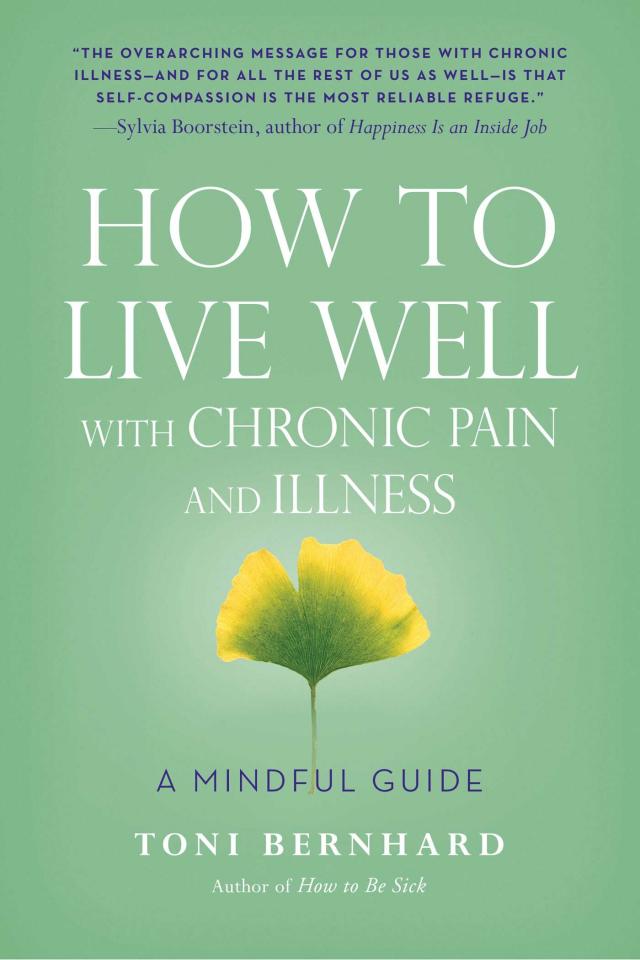
A man in the depression forum I had just started suggested I read Toni Bernhard’s book, How to Be Sick — and learn how to live “around” my symptoms instead of putting so much energy into trying to make them disappear. A few paragraphs into her book, I felt profound relief. A former law professor and dean, Bernhard contracted a mysterious viral infection on a trip to Paris in 2001 and has had flu-like symptoms ever since. Many days she is confined to her bed, and yet her life is full of meaning. In her new book, How to Live Well With Chronic Pain and Illness, she writes:How to Live Well

Many people think it’s their fault when they become chronically ill. They see it as a personal failing on their part. We live in a culture that reinforces this view by bombarding us with messages about how, if we’d just eat this food or engage in that exercise, we need never worry about our health. For many years, I thought that the skillful response to my illness was to mount a militant battle against it. All I got for my efforts was intense mental suffering — on top of the physical suffering I was already experiencing.

The pivotal moment for me came when I realized that, although I couldn’t force my body to get better, I could heal my mind. From that moment, I began the process of learning (to reference the title of my first book), “how to be sick,” by which I mean how to develop skills for living gracefully and purposefully despite the limitations imposed by chronic illness…If there’s no escaping our measure of disappointment and sorrow, then the path to peace and well-being must lie in learning to open our hearts and minds to embrace whatever life is serving at the moment. This is a mindfulness practice — mindfulness infused with compassion for ourselves.

I consider Toni my coach and inspiration when it comes to living gracefully within my limits. From her, and from other companions with infuriating health conditions, I have learned that life isn’t about waiting for the storm to pass. It’s not about fixing every symptom so that you can go to a dinner party without anxiety or help your daughter with her homework without abdominal pain. Life with chronic illness is about dancing in the messy wetness, accepting the perspiration of the universe for what it is, and — with the right umbrella and guidance and support from others who have been there — doing an elegant jig in the moment.

Sometimes by allowing yourself to have fun catching a raindrop in your mouth, you can forget about your symptoms.

And you can be set free.

Join the “Living With Chronic Illness” group on ProjectBeyondBlue.com, the new depression community.

Originally posted on Sanity Break at Everyday Health.

Posted in News & updates | Leave a comment

Childhood Trauma: Focus on Validating Feelings

When you’re a child and you suffer abuse, whether it’s physical, sexual, or emotional, you make it your mission to find out if this is normal. You wonder if other kids experienced the same things.

It’s easier to doubt your perception than it is to accept the fact that you are living in a dangerous situation. If you knew that to be true, you’d have to do something about it. You’d have to talk to a teacher, a school counselor, or a police officer. You’d have to expose something that brings you great shame and pain. You’d have to face your abuser. Even though you’re only a child.

As a child, you can’t walk to school on your own, you don’t understand fractions, you don’t know what the economy is, and your best friend is your best friend because you brought the same cookies for lunch on the first day of school. For a child, life is simple and small. Abuse is not.

You don’t understand what’s happening to you. You wonder if it’s just something you did. Perhaps you’re just deeply flawed and deserve to be treated this way. You wonder if your perception is all wrong. As a child, your experiences are limited, and gauging whether or not other kids are experiencing the same abuse is tricky.

I recall my own experience. I remember having asked myself almost every day, “Is this normal? Is it just me?” I know that I didn’t want to be direct in asking my friends about it because I didn’t want to expose my own experience. I was deeply ashamed of what happened to me. Sometimes I even believed I deserved to be abused. I thought that telling my friends about it would make them disgusted with me.

What I had to learn was that it’s the feelings that matter. It’s not helpful to focus on the abusive event, the motivation of the abuser, and the rate at which other people experience similar abuse. The thing that is most important is… How it makes you feel.

Abusers don’t want you to trust your feelings. They tell you — maybe explicitly but definitely implicitly — that your feelings don’t matter.

That was drilled into my head. I was taught that my feelings weren’t trustworthy. In fact, my feelings were a total nuisance because they were constantly at odds with my abuser’s. Things were the way my abuser said they were and nothing more. My abuser decided if I had any rights to my body or personal space, if I have the right to cry or complain. When I felt disgust, self-pity, fear, or any other negative emotion, I was told it was wrong. My abuser told me how to feel.

It’s taken years to learn to trust my instincts because that would mean embracing my feelings. What is instinct if not a feeling? What is anxiety if not an emotion cluing you into the fact that you are in danger? And certainly feelings aren’t facts, but you don’t have to tell that to an abuse survivor. Survivors take to ignoring their feelings because it was the only way to survive.

In order to move on though, you have to give yourself permission to stop weighing the trauma, measuring it’s perimeter, and scrutinizing each detail. Trust your feelings. No one should ever make you feel degraded, insignificant, or miserable. A person who loves and cares about you doesn’t make you hate yourself. This might sound obvious and you may understand this when it comes to how you treat your own friends and loved ones. But this is about how you were treated.

Console the child inside by accepting the feelings you have about the abuse without judgment. Validate yourself.

“Validating yourself is like glue for fragmented parts of your identity,” writes Karyn Hall, PhD. “Validating yourself will help you accept and better understand yourself, which leads to a stronger identity and better skills at managing intense emotions.”

You have a right to your feelings, you are the sole authority on your own experience, and you deserve comfort and safety. Understand that your emotional reaction to the abuse was normal. Any child would have reacted the same way. Now it’s time to validate those feelings to help you move on from that childhood trauma and give yourself the life you always deserved.

Marmion/Bigstock

Posted in News & updates | Leave a comment

Unbreakable Kimmy Schmidt: Coping with Trauma

The original 2015 Netflix series Unbreakable Kimmy Schmidt, starring Ellie Kemper, is pure comedy at its finest as quirky — and certainly bubbly — 29 year-old Kimmy Schmidt moves from Indiana to New York City for a fresh start. She finds a home with Titus, the dramatic and eccentric roommate looking for stardom (played by Tituss Burgess), has adventures with Lillian, the tough-as-nails and offbeat landlord (played by Carol Kane), and begins to work as a nanny for Jacqueline, a snobby but lovable socialite (played by Jane Krakowski).

But underneath the literally laugh out loud dialogue and hilarity is a serious — and comparatively unique — storyline. In episode one, we learn that Kimmy was kidnapped along with three other young women by a reverend who told them the world was ending; she spent fifteen years of her life immersed in an apocalypse cult, living in an underground bunker until they were finally freed.

And as wondrous as it is for Kimmy to have a second chance at life, you could imagine she may have some post traumatic stress to confront. After all, while she was living in the bunker for fifteen years, her main objective was to adapt to the experience. And to survive.

In season one, we find Kimmy back in the real world again. Her lack of awareness regarding pop culture or societal trends or famous news headlines surely gives way to humor, and her immense drive to surpass her past and move on is admirable. We watch Kimmy help friends who are struggling, take G.E.D courses and even become entangled in a love triangle. And through it all, Kimmy upholds an extremely optimistic disposition. (Though I should note that Kimmy does have a bright disposition, in general).

However, remnants of Kimmy’s kidnapping seep in between the cracks. We see her have a night terror; we see her highly startled from various triggers; we see her react to those triggers with aggression; and, we see her deal with unpleasant moments by counting to ten (an exercise she practiced in the bunker).

In one episode, Kimmy contemplates having plastic surgery. She does not desire recognition; she does not want her experience of victimization to define her. But before she can go through with the procedure, she realizes that fixing the outside won’t matter. Fixing the inside is what counts.

While it’s hinted at that Kimmy would benefit from talking to someone, it’s season two that truly showcases Kimmy’s progress. We see her have flashbacks and erratic sleep patterns and indigestion issues (insinuating she may have some emotional purging to do). We see her put others needs before her own, as if she doesn’t value her own needs at all; as if she’s simply invisible.

When she wakes up on a roller coaster and doesn’t know how she got there, she knows that’s her ‘wake up call’ to seek professional help.

And while her therapist has her own set of problems (played by Tina Fey), Kimmy does begin to deal with not only what happened in the bunker, but deep-seated emotions that preceded her kidnapping, too. (And I don’t want to be a “spoiler,” but let’s just say she has some unfinished issues with her mother.)

Another motif worth mentioning is the strong feminist approach to the show as well; feminist in the sense that these women survived such adversity and will continue to acquire the strength they need to live their lives.

In a 2015 interview with Ellie Kemper for Collider, she’s asked how she balances Kimmy’s optimism with her strength, and how she still finds the humor in such a role.

“What makes this character very special is that, sure, if you saw her at the post office, you might think, ‘Oh, here’s a woman in bright pink pants with red hair who’s smiling,’ but you never would guess the resilience that lies inside,” Kemper said. “That union of traits is what makes her so special. She’s not hardened by it. She’s still optimistic and wanting to believe that the best can happen. She wasn’t defeated by this horrible thing.”

Unbreakable Kimmy Schmidt is not your average television series. It’s multi-faceted with emotional depth, relaying the inspirational message that resiliency can always be fostered — that trauma could lead to redemption.

Debby Wong/Bigstock

Posted in News & updates | Leave a comment