
Stress Management

Stress management encompasses techniques intended to equip a person with effective coping mechanisms for dealing with psychological stress.

Definition of stress: Stress management defines stress precisely as a person’s physiological response to an external stimulus that triggers the “fight-or-flight” reaction.

Causes of stress: Many things can trigger the stress reaction, including danger, threat, news, illness, as well as significant changes in one’s life such as the death of a loved one.

Techniques of stress management include:

  • Self-understanding (e.g. self-identification as a Type A or as a Type B personality)
  • Self-management (e.g. becoming better-organized)
  • Conflict resolution
  • Adopting a more Positive attitude
  • Self-talk
  • Breathing exercises
  • Meditation
  • Exercise
  • Altering your diet
  • Taking more regular and effective rest


Time Management Techniques

Some techniques of time management may help a person to control stress. For example:

  • Becoming more organized and reducing the generation of clutter
  • Setting priorities can help reduce anxiety
  • Using a “to do” list of tasks that a person needs to complete can give a person a sense of control and accomplishment


Effective stress management involves learning to set limits and to say “No” to some demands that others make.


Manage and Reduce your Stress

If you are one of the many people who want to alleviate your stress, you can learn some simple techniques to help you get out of the vicious cycle of leading a stressful life. Your stressful life does not just affect you, but everyone around you. It affects your relationships as well as any children or co-workers. Most of all, it can actually make you physically ill.

There are many facets to stress. Stress manifests itself in many differnet ways and can be either self induced or something that occurs in life. We can never eliminate stress from our lives as stressful situations are part of life. However, we can learn to react to stress in a positive manner and take control of the situation rather than allowing the stress to remain in control. This book will teach you different tips as well as old secrets on how to identify the stressors in your life as well as learn to manage them.


Psychologist World Stress Management Manual: Downloadable Edition

Once you realize what stress actually is and how it manifests itself in your life, it is much easier to gain control. Most of us experience stress because we feel out of control over a particular situation. While we may not always be able to eliminate the factor that is causing the stress in our lives, it is possible to control our reactions to the stress.

By controlling our reactions in a positive manner, we can not only alleviate the stress, but actually get it to work in our favor. If you have been experiencing stress in your daily life and do not know how to regain some sort of sense of order in your life, this is the perfect book for you. Here you can learn positive ways to deal with every day stress. You can also learn the difference between the stressors that you can eliminate from your life and those with which you simply have to endure. We all have to endure stress in some aspects of our life – it is unavoidable. Wouldn’t you rather know how to deal with stress in a positive way, instead of a negative, potentially self-destructive manner?

If you want to learn how to break free of the cycle of living a stressful life and get a sense of harmony back into your existence, The Psychologist World Stress Management Manual can teach you the right way to go about living a healthy life that involves positive reactions to stress in a way that will help, not harm, you.

If you want to learn exactly how you can go about leading a less stress filled life for your own benefit as well as for the sake of anyone around you, you can learn everything you need to know and more when you read:

  • Learn How To Identify Stressors In Your LifeEveryone experiences stress. Stress can come from a variety of different situations that can be good or bad. It can also come from within. The trick to managing stress in your life is to be able to identify stressors and understand if they are from outside sources or if they are self induced. Learning how to eliminate some stressors an simply deal with others is not difficult once you learn the secrets that are revealed in Psychologist World Stress Management Manual. This book has everything you need to know to getting started on a more relaxed lifestyle.
  • Learn How To React To StressThe Psychologist World Stress Management Manual not only gives you easy to understand details of what you need to live a happier life by giving you some real life examples of others who have also experienced stress, but it offers in easy to understand language just how to react to stress in a positive way. Although you cannot control some stress factors, you can control how you react to stress. By learning the tips in this self-improvement guide, you are on your way to a more tranquil lifestyle.


The Psychologist World Stress Management Manual
Posted in Coping mechanisms | Leave a comment

Unconscious Ideas

Now I turn to unconscious ideas. Deriving them was not easy. Some emotions occur three times ; for example, self-pity occurs on its own, as a mode of jealousy, and as a mode of guilt, and each one produces a different response. To work out the underlying idea, the overall theme or motif of the emotion needs to be considered, that is, what the emotion is trying to express. Also, in a doublet, one unconscious idea needs to be harmonious with the other one. Below are the results that I derived.

I use the word �implies’ to indicate the central idea that determines a particular emotion. These ideas are focused on relationships. When a relationship is not the issue, then different responses may occur. For example, the vanity mode of pride, when applied to crafts, produces the satisfaction of doing good work.

Table 2 :Unconscious Ideas
  • The motif of guilt and pride is punishment / humiliation
    Guilt is self-punishment
    self-pity mode implies life is punishment.
    self-hate mode implies I deserve punishment.

    Pride is punishment / humiliation of other people.
    vanity mode implies you are inferior to me.
    hate mode implies I despise you / I will punish you.

  • The motif of jealousy and narcissism is responsibility
    Jealousy is social responsibility.
    self-pity mode implies I need a reward (from other people).
    love mode implies I reward other people.
  • Narcissism is self-responsibility.
    vanity mode implies I will do it my way.
    love mode implies I do not depend on anyone.
  • The motif of self-pity and vanity is help
    Self-pity implies I need help.
    Vanity implies I do not need any help.
  • The motif of anger and fear is domination
    Anger implies I need to dominate other people
    Fear implies the world is dominating me.
  • The motif of love and hate is identity
    Love implies I am the same as everyone else.
    Hate implies I am different from everyone else.
  • The motif of envy and greed is the need to acquire importance
    Envy implies I become important if I can get what you have.
    Greed implies I become important if I possess things.
  • The motif of resentment and bitterness is disgust
    Resentment implies people are repulsive.
    Bitterness implies life is repulsive.
  • The motif of paranoia is the betrayal of trust
    Paranoia implies I trust no one.
  • The motif of anxiety is a sense of oppression by one’s conscience or by other people
    fear mode implies do as you are told / control yourself.
    vanity mode implies I am uneasy in the presence of other people.

Depression arises from self-pity; there are three forms of the latter, so there are three forms of the former.

The most common type arises from jealousy (mode of self-pity) and is the depressive stage of manic depression. Guilt-based depression (or �endogenous’ depression) has its source in the infant’s traumatic experience of parental relationships and represents a response to the feeling of being rejected. Depression that arises from self-pity may be seen in political refugees denied asylum, and in anyone who is a victim of injustice. [4]

  • The motif of manic depression is victimisationdepression mode implies I am a victim.
    mania mode implies I help victims.
  • The motif of guilt-based depression is self-denigration
    Depression implies I am a sinner.
  • The motif of depression based on self-pity is the absence of equity or fairness
    Depression implies there is no equity, no fairness in life.

These ideas enable me to state how motivation is usually handled by the subconscious mind.

Subconscious motivation usually means the influence of the current subconscious mood and its associated ideas.

By dwelling on an associated idea, an emotion becomes prolonged into a mood. Since moods change frequently, this form of motivation is short-term. Long-term subconscious motivation requires a subconscious desire, but unless this desire is powered by idealism it is likely to be much weaker as an influence on the ego than any mood.

Copyright © 2002 Ian Heath. All Rights Reserved

Posted in Coping mechanisms | Leave a comment

Emotion: Unconscious Ideas The unconscious and emotions.


The mental concept that is associated with an emotion actually creates the boundaries of that emotion. If the mental concept changes, the emotion does not change ; instead, it fades away and a different emotion arises, one that fits the current mental concept. The mental concepts of emotions are not normally a part of our awareness. Emotions are not unique to any particular individual, so the mental concepts that underlie them come from the unconscious mind. Since the mental concepts are unconscious they are extremely difficult to identify. The mental concept is normally unconscious, so I call it an unconscious concept or an unconscious idea.

At this point I need to clarify my usage of two important terms.

I use the term �subconscious mind’ for what is personal to the individual, and the term �unconscious mind’ for what is general to humanity. [²]

An emotion is not unique to any particular individual, so the mental concept that underlies it comes from the unconscious mind.

Now an unconscious idea has two values : it is good or it is bad. The good value generates the pleasant feeling, the bad value the unpleasant feeling. This division leads to two choices. One choice gives rise to one emotion, the other choice to its complement.

In general, the definition of an emotion is that it is an unconscious idea powered by either a pleasant or an unpleasant feeling.

No feeling is permanent. There is a constant oscillation between the positive and negative feelings. Emotions are constantly changing, in part because feelings change, and in part due to the constant stream of ideas that flow in the unconscious mind. At the conscious and subconscious levels of mind we can focus on an unconscious idea and use it to pursue a trend or theme about something that interests us at that moment. Hence we can make an emotion last whilst we follow that trend.

The difference between the flow of ideas at the conscious and subconscious levels is mainly related to the issue of change. The conscious flow is easy to change, especially when we are in social company, but the subconscious flow seems to have a life of its own and is highly resistant to conscious attempts to change it. In social company or if we are idealistic we can give preference to our conscious ideas, and hence control our conscious emotional response. But on our own, without the influence of idealism, the subconscious mind usually exerts priority in emotional response. If the conscious mind is not dominant, that is, if we do not value what we are doing at any particular moment, then the subconscious mind is dominant (and so we may become subject to uncontrollable moods).

As I show below, emotions can be grouped into complementary pairs. I call these pairs �binaries’. A few lines above I used two examples of binary emotions. I paired anger and fear together, and then love and hate together. Another binary is vanity and self-pity. What determines the choice of either emotion in a pair ? For example, what governs a person, at a particular moment, in their selection of either anger or fear as their response to something? The choice is not a random one. The choice revolves around the dominating influence of value.

We put a value on emotional experience. By either liking or disliking things, relationships, situations, etc we put a value on them. At any particular moment we may either like or dislike something ; but this liking and disliking can take many forms. For example, the way that we like that something may lead us to choose between anger, love or vanity as our response. Anger allows us to dominate the situation ; love enables us to harmonise with other people ; vanity lets us feel important. The way that we dislike it may focus on fear, hate or self-pity.

So at any particular moment we are focusing on a trend of thought, with a relevant emotion being experienced. Then there is some change in the situation that needs an emotional response from us. Sometimes we can consciously choose our response, particularly if the situation is a pleasant one. But more often than not we act subconsciously. The value that we place on the situation at that moment determines which emotion will be felt. For example, if we are feeling discontented, we will place little positive value on our present experience ; then when we have to respond to something we are more likely to choose some form of hostile or fearful response.

As well as putting value on our situations, we also put value on our thoughts and ideas. Now an unconscious idea has two values : it is good or it is bad. The good value is supported by the pleasant feeling, the bad value by the unpleasant feeling. This division leads to two choices. One choice gives rise to one emotion, the other choice to its complement. Hence emotions can be grouped into complementary pairs, or binaries.

In general then, if we are free-wheeling in our thoughts, we can let our emotions be positive or negative according to whether the feeling is positive or negative. Otherwise, by placing value on our experience, we can generate positive or negative emotions as we choose. However, the generation of a positive emotion is often difficult if the feeling that is current is the negative one, and vice versa.

The unconscious idea enables all emotions to be arranged in pairs of complementary opposites. The one exception is that the neutral feeling is unique, it is not part of a binary. It is the basis of equanimity, the ability to be unaffected by any kind of stress. Equanimity should not be confused with indifference or even peace ; indifference is a protective mechanism of withdrawal from responsibility and is underpinned by fear, whilst peace is achieved by repressing internal conflict (that is, conflict that is within the mind of a person).

In psychological language, equanimity is the state of mind which denotes the absence of projection and introjection. When a person uses the mechanisms of projection and introjection, they are making value judgements about the characteristics of other people that they admire or dislike. When they cease making such value judgements, they thereby cease to desire anything of a personal nature. [³]

I list some emotions which are binary to each other :

fear – anger
love – hate
jealousy – narcissism
pride – guilt
vanity – self-pity
resentment – bitterness

Some emotions have an additional complexity: they are compound and consist of two simpler emotions. I call such an emotion either a compound emotion or a �doublet’, and each of the separate emotions within a doublet I call a �mode ‘ of that doublet. For example, guilt comprises the two simpler emotions of self-pity and self-hate. So guilt is experienced as guilt (in the mode of self-pity) or as guilt (in the mode of self-hate).

I list some compound emotions and then I give a table of unconscious ideas that determine emotions.

Table 1: Compound Emotions

Guilt = self-pity + self-hate.
Pride = vanity + hatred of other people.

Narcissism = love + vanity.
Jealousy = love + self-pity.

Resentment = guilt + idealism.
Bitterness = pride + idealism

Repentance = regret + guilt (mode of self-pity).
Sadness = regret + jealousy (mode of self-pity).

Paranoia = fear + pride (mode of vanity).
Anxiety = fear + vanity.

In the compound emotions of guilt, pride, narcissism, and jealousy, only one mode is felt at any one time � they are never experienced simultaneously. For example, guilt is felt as either self-pity or as self-hate.

How do I know that some emotions are compound ones ? Guilt was the first one that I identified. Once I learned to detect guilt by empirical awareness I became puzzled by the fact that it seemed to exhibit contrary impressions. Then I realised that this difficulty could be explained by postulating that guilt consisted of two factors. It then became an empirical task to see if I could detect these two separate factors � and I did.

Now guilt equals self-pity plus self-hate. This arrangement of the two emotions within guilt has three other possible combinations, by taking the binaries of self-pity and self-hate. So if my factorisation of guilt was correct then three other compound emotions should also exist, with their factors being:

self-pity + love

vanity + love

vanity + hate

Eventually I realised through intuition that these compound emotions represented jealousy, narcissism, and pride. Then again I empirically verified that my theorising was correct. The hallmark of a compound emotion is that it produces ambiguous responses ; the ambiguity always falls into two categories, thus indicating that two factors are present and need to be separated.

For example, in sadness there is sorrow (from the regret) plus a sweetness (from the jealousy). When the jealousy factor is highlighted, then I always find that sadness is a lovely emotion in which I often like to linger, whereas the sorrow element makes sadness unpleasant.


Posted in Coping mechanisms | Leave a comment

Model of Emotions More information on emotions.

Emotions are partly derived from feelings. To explain how this derivation occurs I use a model of consciousness that is a traditional one: consciousness has three modes, those of will, mind, and feeling. Past variations on this model substituted action for will, and emotion or sensibility for feelings. In this model I distinguish between consciousness and mind. Consciousness is the totality of the person, whilst mind is only one feature of it. However, my model has an innovative feature: the three modes are separate, but they interlock by the production of desires and emotions.

In this model, mind has two aspects, intelligence and intellect. Intelligence links to will and to feeling, and intellect is the source of abstraction. The former expresses the activity of the mind, whilst the latter is an indication of the degree of maturity of the mind. [¹]

Mind is the key to consciousness. Mind, in fact, is the �cement’ that keeps all aspects of consciousness together.

Now the mind helps to produce desires and emotions. In this aspect of mind we use ideas or concepts.

I give definitions of desire and emotion that brings out their reliance on concepts.

Will is a pure striving, an undirected effort. When will is united with mind, it generates desire. Desire is the activity of will directed into a mental concept. The concept governs the use of will. The concept directs the will.

For example, will plus the concept �social status’ gives rise to the desire to achieve social status. Will plus the concept �fame’ gives rise to the desire for fame. Without the presence of desire it is very difficult to sustain the use of will ; if a person tries to renounce desire then he / she is quite likely to become lethargic.

When feeling is united with mind, it generates emotion. Emotion is the activity of feeling directed into a mental concept. The feeling energises a conceptual response to a stimulus. Feelings are primarily either pleasant or unpleasant; rarely are they neutral. Hence there are two possible conceptual responses to any stimulus, which in turn leads to two possible emotional responses.

For example, feeling plus the concept �domination’ gives rise to the emotions of anger and fear : anger arises because the pleasant feeling makes domination of others acceptable to me, whereas the unpleasant feeling makes fear arise when I become subject to domination by others.

For another example: feeling plus the concept �identity’ gives rise to the emotions of love and hate. Here the pleasant feeling makes a social identity acceptable to me, since I am the same as everyone else: identity produces love. The unpleasant feeling makes me reject a social identity � I prefer to be different and have an individual identity: difference produces hate.

Copyright © 2002 Ian Heath. All Rights Reserved

Posted in Coping mechanisms | Leave a comment

Emotion Guide

Why do people and animals experience emotions, and what makes us experience different types of emotions. Ian Heath looks at emotional states, the link between the sub-conscious and our feelings.

The analysis of emotions has been ineffectual up till now since they are very difficult to identify, except for a few such as fear and anger. Many years ago I began an intense psycho-analysis (which I did on my own). It took me five years of constant awareness to finally identify the range of emotions that I usually experience.

The peculiarity of any particular emotion is that, whilst it is just an emotion, it is nevertheless intimately associated with specific mental attitudes and ideas that have become characteristic of that emotion. In general, I found that each emotion acts as a nucleus for pre-set ideas about the world. This fact gives rise to a notable phenomenon. As one emotion fades away and the next one is generated, so the ideas in a person’s mind automatically change : the fresh emotion brings with it its associated ideas.

A person is always experiencing some emotion at any time, since when the present emotion fades away so another emotion will take its place and be felt by him / her. No single emotional response can be permanent. When any emotion, such as anger, is experienced the person can stay angry only for some time ; eventually the anger will fade away and a fresh emotion will arise.

Many people orientate on feeling responses to the world: an abundance of good feelings, and emotional satisfaction, become the criteria for a successful life. However, emotions present problems for the ego. When emotions become intense they neutralise intellectual concerns. In fact, common negatively-valued emotions such as self-pity, fear, anxiety, as well as moods like depression, actually tend to inhibit rationality � in particular, intense anxiety seems to produce a mental fog in one’s mind, making it impossible to study.

Understanding the nature of emotions has profound implications for psycho- therapy. In this set of three articles I present my ideas on emotion. In the subsequent set of five articles on abreaction I focus on their relevance to psycho-therapy and the development of self-awareness.

Emotion: Feelings

One area of confusion is that feelings are often loosely equated with emotions. This is all right for colloquial use. I can ask a friend how he is feeling today ; it would be awkward to ask him how emotional he is being today. Some people might take offence if they were thought to be emotional, whereas it is acceptable for them to show feelings. However, there are fundamental differences between feelings and emotions.

There are just three feelings : the pleasant one, the unpleasant one, and the neutral one. This is the Buddhist understanding and I verified this fact directly during the time when I used to practise meditation. In the past, some moral theorists believed that the neutral feeling is only an equal mixture of both pleasant and unpleasant feelings, so that the net effect is zero. But meditational awareness disproves this assumption.

Copyright © 2002 Ian Heath. All Rights Reserved


Posted in Coping mechanisms | Leave a comment

Guided Meditation

Guided Meditation

Although there is no substitute for doing guided meditation in the presence of a guru or a master, it is quite often not possible to find an accomplished teacher in your close vicinity. The other alternative is to watch the videos or listen to audios of the guided meditation prepared by the realized masters.

Guided meditation means that the teacher guides your thought process, which you follow like listening to your teachers in your schools and colleges.

While the meditation teacher is speaking, he is, in fact, taking you along on a journey of a whole new beautiful and blissful world, which is altogether different from this world. Although he may build up and correlate his theme of meditation on this world, he may suggest a line of refreshing and powerful thought process. The effect of meditation guided by a realized master will appear like a fresh, pure and blissful lotus emerging out of slush and mud of negative thoughts and mundane tensions.

The language may start in first person:

I am a spiritual being.
I am able to relax my mind.
I am a positive, blissful and compassionate soul.
I take charge of my thoughts and feelings to only allow peaceful thougths and feelings of peace.

These or similar positive affirmations are repeated almost on daily basis till they become an integral part of our thought process.

Posted in Meditation | Leave a comment

Poem

There comes a point in your life,

when you realize who really matters,

who never did, and who always will….

Posted in Poetry Corner | Leave a comment

Unconscious Ideas and Emotions

No feeling is permanent. There is a constant oscillation between the positive and negative feelings. Emotions are constantly changing, in part because feelings change, and in part due to the constant stream of ideas that flow in the unconscious mind. At the conscious and subconscious levels of mind we can focus on an unconscious idea and use it to pursue a trend or theme about something that interests us at that moment. Hence we can make an emotion last whilst we follow that trend.

The difference between the flow of ideas at the conscious and subconscious levels is mainly related to the issue of change. The conscious flow is easy to change, especially when we are in social company, but the subconscious flow seems to have a life of its own and is highly resistant to conscious attempts to change it. In social company or if we are idealistic we can give preference to our conscious ideas, and hence control our conscious emotional response. But on our own, without the influence of idealism, the subconscious mind usually exerts priority in emotional response. If the conscious mind is not dominant, that is, if we do not value what we are doing at any particular moment, then the subconscious mind is dominant (and so we may become subject to uncontrollable moods).

As I show below, emotions can be grouped into complementary pairs. I call these pairs �binaries’. A few lines above I used two examples of binary emotions. I paired anger and fear together, and then love and hate together. Another binary is vanity and self-pity. What determines the choice of either emotion in a pair ? For example, what governs a person, at a particular moment, in their selection of either anger or fear as their response to something? The choice is not a random one. The choice revolves around the dominating influence of value.

We put a value on emotional experience. By either liking or disliking things, relationships, situations, etc we put a value on them. At any particular moment we may either like or dislike something ; but this liking and disliking can take many forms. For example, the way that we like that something may lead us to choose between anger, love or vanity as our response. Anger allows us to dominate the situation ; love enables us to harmonise with other people ; vanity lets us feel important. The way that we dislike it may focus on fear, hate or self-pity.

So at any particular moment we are focusing on a trend of thought, with a relevant emotion being experienced. Then there is some change in the situation that needs an emotional response from us. Sometimes we can consciously choose our response, particularly if the situation is a pleasant one. But more often than not we act subconsciously. The value that we place on the situation at that moment determines which emotion will be felt. For example, if we are feeling discontented, we will place little positive value on our present experience ; then when we have to respond to something we are more likely to choose some form of hostile or fearful response.

As well as putting value on our situations, we also put value on our thoughts and ideas. Now an unconscious idea has two values : it is good or it is bad. The good value is supported by the pleasant feeling, the bad value by the unpleasant feeling. This division leads to two choices. One choice gives rise to one emotion, the other choice to its complement. Hence emotions can be grouped into complementary pairs, or binaries.

In general then, if we are free-wheeling in our thoughts, we can let our emotions be positive or negative according to whether the feeling is positive or negative. Otherwise, by placing value on our experience, we can generate positive or negative emotions as we choose. However, the generation of a positive emotion is often difficult if the feeling that is current is the negative one, and vice versa.

The unconscious idea enables all emotions to be arranged in pairs of complementary opposites. The one exception is that the neutral feeling is unique, it is not part of a binary. It is the basis of equanimity, the ability to be unaffected by any kind of stress. Equanimity should not be confused with indifference or even peace ; indifference is a protective mechanism of withdrawal from responsibility and is underpinned by fear, whilst peace is achieved by repressing internal conflict (that is, conflict that is within the mind of a person).

In psychological language, equanimity is the state of mind which denotes the absence of projection and introjection. When a person uses the mechanisms of projection and introjection, they are making value judgements about the characteristics of other people that they admire or dislike. When they cease making such value judgements, they thereby cease to desire anything of a personal nature. [³]

I list some emotions which are binary to each other :

fear – anger
love – hate
jealousy – narcissism
pride – guilt
vanity – self-pity
resentment – bitterness

Some emotions have an additional complexity: they are compound and consist of two simpler emotions. I call such an emotion either a compound emotion or a �doublet’, and each of the separate emotions within a doublet I call a �mode ‘ of that doublet. For example, guilt comprises the two simpler emotions of self-pity and self-hate. So guilt is experienced as guilt (in the mode of self-pity) or as guilt (in the mode of self-hate).

I list some compound emotions and then I give a table of unconscious ideas that determine emotions.

Table 1: Compound Emotions

Guilt = self-pity + self-hate.
Pride = vanity + hatred of other people.

Narcissism = love + vanity.
Jealousy = love + self-pity.

Resentment = guilt + idealism.
Bitterness = pride + idealism

Repentance = regret + guilt (mode of self-pity).
Sadness = regret + jealousy (mode of self-pity).

Paranoia = fear + pride (mode of vanity).
Anxiety = fear + vanity.

In the compound emotions of guilt, pride, narcissism, and jealousy, only one mode is felt at any one time � they are never experienced simultaneously. For example, guilt is felt as either self-pity or as self-hate.

How do I know that some emotions are compound ones ? Guilt was the first one that I identified. Once I learned to detect guilt by empirical awareness I became puzzled by the fact that it seemed to exhibit contrary impressions. Then I realised that this difficulty could be explained by postulating that guilt consisted of two factors. It then became an empirical task to see if I could detect these two separate factors � and I did.

Now guilt equals self-pity plus self-hate. This arrangement of the two emotions within guilt has three other possible combinations, by taking the binaries of self-pity and self-hate. So if my factorisation of guilt was correct then three other compound emotions should also exist, with their factors being:

self-pity + love

vanity + love

vanity + hate

Eventually I realised through intuition that these compound emotions represented jealousy, narcissism, and pride. Then again I empirically verified that my theorising was correct. The hallmark of a compound emotion is that it produces ambiguous responses ; the ambiguity always falls into two categories, thus indicating that two factors are present and need to be separated.

For example, in sadness there is sorrow (from the regret) plus a sweetness (from the jealousy). When the jealousy factor is highlighted, then I always find that sadness is a lovely emotion in which I often like to linger, whereas the sorrow element makes sadness unpleasant.

Unconscious Ideas

Now I turn to unconscious ideas. Deriving them was not easy. Some emotions occur three times ; for example, self-pity occurs on its own, as a mode of jealousy, and as a mode of guilt, and each one produces a different response. To work out the underlying idea, the overall theme or motif of the emotion needs to be considered, that is, what the emotion is trying to express. Also, in a doublet, one unconscious idea needs to be harmonious with the other one. Below are the results that I derived.

I use the word �implies’ to indicate the central idea that determines a particular emotion. These ideas are focused on relationships. When a relationship is not the issue, then different responses may occur. For example, the vanity mode of pride, when applied to crafts, produces the satisfaction of doing good work.

Table 2 :Unconscious Ideas
  • The motif of guilt and pride is punishment / humiliation
    Guilt is self-punishment
    self-pity mode implies life is punishment.
    self-hate mode implies I deserve punishment.

    Pride is punishment / humiliation of other people.
    vanity mode implies you are inferior to me.
    hate mode implies I despise you / I will punish you.

  • The motif of jealousy and narcissism is responsibility
    Jealousy is social responsibility.
    self-pity mode implies I need a reward (from other people).
    love mode implies I reward other people.
  • Narcissism is self-responsibility.
    vanity mode implies I will do it my way.
    love mode implies I do not depend on anyone.
  • The motif of self-pity and vanity is help
    Self-pity implies I need help.
    Vanity implies I do not need any help.
  • The motif of anger and fear is domination
    Anger implies I need to dominate other people
    Fear implies the world is dominating me.
  • The motif of love and hate is identity
    Love implies I am the same as everyone else.
    Hate implies I am different from everyone else.
  • The motif of envy and greed is the need to acquire importance
    Envy implies I become important if I can get what you have.
    Greed implies I become important if I possess things.
  • The motif of resentment and bitterness is disgust
    Resentment implies people are repulsive.
    Bitterness implies life is repulsive.
  • The motif of paranoia is the betrayal of trust
    Paranoia implies I trust no one.
  • The motif of anxiety is a sense of oppression by one’s conscience or by other people
    fear mode implies do as you are told / control yourself.
    vanity mode implies I am uneasy in the presence of other people.

Depression arises from self-pity; there are three forms of the latter, so there are three forms of the former.

The most common type arises from jealousy (mode of self-pity) and is the depressive stage of manic depression. Guilt-based depression (or �endogenous’ depression) has its source in the infant’s traumatic experience of parental relationships and represents a response to the feeling of being rejected. Depression that arises from self-pity may be seen in political refugees denied asylum, and in anyone who is a victim of injustice. [4]

  • The motif of manic depression is victimisationdepression mode implies I am a victim.
    mania mode implies I help victims.
  • The motif of guilt-based depression is self-denigration
    Depression implies I am a sinner.
  • The motif of depression based on self-pity is the absence of equity or fairness
    Depression implies there is no equity, no fairness in life.

These ideas enable me to state how motivation is usually handled by the subconscious mind.

Subconscious motivation usually means the influence of the current subconscious mood and its associated ideas.

By dwelling on an associated idea, an emotion becomes prolonged into a mood. Since moods change frequently, this form of motivation is short-term. Long-term subconscious motivation requires a subconscious desire, but unless this desire is powered by idealism it is likely to be much weaker as an influence on the ego than any mood.

Copyright © 2002 Ian Heath. All Rights Reserved

Posted in News & updates | Leave a comment

Forgetting

Do we really forget?

Many people think that the human mind is too complex to explain, and memory is no exception. Even though vast amounts of research have been carried out into how we remember (and forget!) things, nobody knows for sure the model on which human memory is based.

There are, nonetheless, two main reasons for which psychologists think we ‘forget’ information:

  • You store information in your memory but are unable to remember it when you need to, but perhaps can at a later date. In this case, information is inaccessible
  • The human memory simply forgets information, permenantly, and the physical traces of the memory disappear. In which case, information is unavailable

How We Forget

It’s though that how we forget differs depending on whether a memory is stored in our long term or short term memory.

In Short-Term Memory

There are three ways in which you can forget information in the STM:

  1. Decay
    This occurs when you do not ‘rehearse’ information, ie you don’t contemplate it. The physical trace of such memory is thought to fade over time.
  2. Displacement
    Displacement is quite literally a form of forgetting when new memories replace old ones. Everyone knows the potentially vast capacity of memory, particularly long-term memory, but research by Norman has shown that numbers can replace old ones being memorised (using the serial probe technique).
  3. Interference
    It’s sometimes difficult to remember information if you’ve been trying to memorise stuff that’s similar, eg words which sound similar (in 1966, psychologist Baddeley found that participants of his study found it easier to remember words which were more distinguished). Interference can either be proactive (this is when old memories interfere with new ones) or retroactive, when new information distorts old memories.

In Long-Term Memory

Long term is supposed to be limitless in its capacity and length in terms of time. Still though, we can forget information through decay (as in short-term forgetting) and interference from other memories.

Conclusion

Although we evidently can ‘forget’ information, it’s unknown whether information does actually disappear from memory. In hypnosis, memories which we never knew still existed can be recalled from early childhood using regression, calling into question – can we really forget?

Posted in News & updates | Leave a comment

Multi-Store Memory Model

An explanation of how we remember

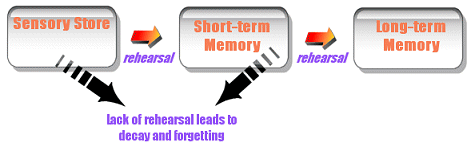
One popular theory of how we remember was proposed by Richard Atkinson and Richard Shiffrin in 1968. It proposed that the human memory is divided into 3 main sections:

Sensory Memory

Information from our environment, such as visual images from the eyes and sound, smell, etc. enter the memory here. The information that enters here may only stay here until it ‘decays’ and is forgotten. But if you pay particular attention to a piece of information – for example, you’re focusing on an object or listening to somebody speak – the information will be passed into the second ‘part’ of our memory…


Short-Term Memory (STM)

The short term memory deals with immediate situations, i.e. the environment we’re in, and memories here may last for hours or days. If they’re not rehearsed – thought about in a deeper way – then they will, like in the sensory memory, decay and be forgotten and the STM as we currently know it has a limited capacity. However, if you repeat information and think about it more deeply it may be passed into the third section of the Multi-Store model of memory – LTM…

How much information can the STM store and how long does it last?

The exact capacity of short term memory is unknown, but Miller proposed a ‘magic number’ of 7 +/- 2 ‘chucks’ of information. For example, you might be able to store a phone number between 5 and 9 digits long depending on how good your STM is. This is one explanation why many US phone numbers are 7 digits long.


Long Term Memory (LTM)

The long term memory contains events and information that’s most important in a person’s life – memorable events, friends and associates’ names, etc. Research by psychologist Barhick has indicated that the LTM has a potentially unlimited capacity and memories here can last for a person’s entire life. Bahrick studied ex-schoolfriends, asking adults how many of their ex-school buddies they could name from old photographs, and found that ex-students could name around 90% of the people pictured upto as long as 34 years after leaving school.

Does the multi-store model add up?

Human minds are extremely complex, and with many ideas in psychology, the multi-store model of our memory has been accused of over-simplifying something which defies any basic explanation. However, case studies of brain damaged people have indicated that memory might consist of a number of ‘sections’ as proposed, because some sufferers experience problems solely with their short term memory, while old memories from before accidents remain intact. Likewise, a person involved in an accident may lose all their previous memories, but still be able to function as normal afterwards, indicating that their short term memories are fine.

Posted in Coping mechanisms | Leave a comment