Overcome OCD Positive Affirmations

Present Tense Affirmations
I am in control of my mind
I resist compulsive urges
I am individual in thought
I overcome obsessions
I control unwanted behaviors
I am in charge of my thoughts
I am only under the influence of myself
I do and say what I want
I have power over my impulses
I have authority over OCD


Future Tense Affirmations
I will stop letting compulsive actions get to me
I will break my repetitive routines
My actions will form purely on my own intent
I will stop craving repetition
I will act on my own true desires
I will listen to my own needs
I will accept imperfection
I will enjoy the ups and downs of life
My stress will become manageable
I will overcome my OCD


Natural Affirmations
I am stronger than OCD
I simply don’t have obsessions to worry about
I am independent of obsessive compulsions
My life is without OCD
I simply don’t let compulsive urges get to me
I naturally persevere over any obsessions
I am level-headed
I have a strong will
I am perfect the way I am
Nothing stresses me out
Posted in Affirmations | Leave a comment

Guide to Using Positive Affirmations

The Most Simple Way To Use Positive Affirmations

Ultimately you will find your own style, way to say them, timing etc, but here is a really simple way to start.

  • Stand tall, relax your shoulders and stand with good posture – take a confident standing positon.
  • Have your affirmations infront of you, written down or printed out – especially if it is a new set.
  • Say them one by one, in a slow, confident tone of voice – go down your affirmations list like you mean it, like you believe it, and as if it is actually real or already happened.
  • Speaking slowly and confidently is important. Confident speakers take their time, they don’t rush their words, they pronounce each one properly and speak with meaning.
  • Optionally you can stand at a mirror and look at yourself as you talk. You might find you feel awkward, but with practice this will be normal to you. Standing at a mirror shows you your posture and your confidence so you can ensure you are doing them properly – adjust your voice tone and posture as needed to always stand positively, and look yourself in the eye.
That’s it, that is really all you need – see, positive affirmations aren’t rocket science, get started, put in the time and you will see results!

Add a Little Structure

Getting a little deeper, it is good to add a little structure, and CONSISTENCY.

Consistency is actually key, you need to repeat them day in, day out, so having a real structure, a daily routine will really help. Here is a standard routine for you to try, you can adapt it as needed, but it is a great place to start.

  • Say your affirmations 2x a day.
  • Start in the morning, as soon as you can after waking up. This ensures you have a positive start to the day – that the first thing you start thinking about are your goals and ambitious, and of course, that you are thinking positive thoughts!
  • Say your second set as close as you can before going to bed. This ensures that you have positive thoughts in your mind as you go to sleep, you are thinking about your goals and these will seep into your subconscious mind and solidify as you sleep.
  • Say them multiple times. It is up to you, but we recommend either 5 minute sessions (so just 10 minutes a day total), or alternatively, saying your whole set of affirmations 10x each, in a slow, confident voice – whatever suits you really, don’t take too long, 10-15 minutes is probably too much and they might seem like a chore after some time, 5 minutes really is enough for permanent, lasting change.
Again, that’s it, a little structure is good, try to stick to it – if you really do stick to this structure for 2 weeks then you will see a real difference in yourself! Then it won’t be like a structure you are trying to stick to at all… it will be something you want to do because you will have seen the powerful changes that positive affirmations can produce.

Use Written Affirmations Too!

Written Affirmations on FridgeAn extra step you can take is to write your affirmations down, or just print them out right from our site.

You can pin them up around your house in key places that you will them each day. On the fridge, in your school/work/gym locker, on the inside of your bathroom mirror, on the dashboard of your car.

This just adds a little extra, you will simply see your affirmations randomly each day in the middle of the day, this will just jog your memory and remind you to stay positive and focused on your goals.

When you are constantly reminded about your affirmations and goals like this, you can accelerate your results as it’s not just when you are saying your affirmations that you think about them and your goals, but constantly throughout the day you encounter little reminders and as a result you are always focused and develop a complete consciousness around achieving success and realizing your goals!

Some Extra Tips

So you’re still hungry for information? Good 🙂 Use these extra tips to make sure that you get the most from your positive affirmations practice!

  • Start with a focus. Don’t pick too many subjects at once.
  • Be consistent. Repeat them daily.
  • Make a commitment to do them for 30 days, no matter what. Think long term, and don’t give up.
  • Monitor your mood first. Before you start your daily session, just take 30 seconds to “look inside” yourself, see how you feel, see how your emotions are, do you already feel positive, negative, a little tired.. just take note. Then, say your affirmations, slowly, take your time, and then do a “mood check” again. See how you feel, see how positive you now feel, see how you feel differently about yourself. This can be a great way to gain confidence in your affirmations early on. Before you even see the life changing results you really want, this simple experiment should show you how they can instantly lift your mood and change how you are feeling in an instant and inspire you to keep going so that you really do get to see the bigger and lasting changes you really want!
Posted in Affirmations | Leave a comment

What Are Affirmations and How to Use Them

By Remez Sasson

What Are Affirmations

Affirmations are sentences aimed to affect the conscious and the subconscious mind. The words composing the affirmation, automatically and involuntarily, bring up related mental images into the mind, which could inspire, energize and motivate. Repeating affirmations, and the resultant mental images, affect the subconscious mind, which in turn, influences the behavior, habits, actions and reactions.

What Affirmations Do?

  • They motivate.
  • They keep the mind focused on the goal.
  • They influence the subconscious mind and activate its powers.
  • They change the way you think and behave, and this can bring you into contact with new people, who can help you with your goals.
  • Positive statements make you feel positive, energetic and active, and therefore, put you in a better position to transform your inner and external worlds.

When and How to Repeat Affirmations

1) Devote some special times during the day for repeating them.

2) Repeat them wherever you are, and whenever you want and have the time.

Before starting, ask yourself whether you really want to get what you want to affirm for. If you have doubts and are not really sure that you want it, your doubts will stand in your way. This is one of the reasons why people do not get results, and then lose their belief in this power.

Affirm with love, faith, feeling and interest, and feel and believe that your desire has already been fulfilled. This kind of thinking will accelerate its fulfillment.

It is natural for the mind to bring up doubts and negative thoughts, especially if your current environment and situation are very different from what you want to achieve. Persevere, and do not let your negative thoughts and doubts conquer you.

Examples

Affirmations for success:
It is easy and simple to achieve success.
Success loves me and always seeks me.
Success is flowing now into my life.
The power of the Universe is helping me to achieve my goals.
Every time I inhale, I fill myself with the energy of prosperity.

Affirmations for happiness:
I am letting happiness manifest in my life.
I deserve to be happy right now.
Happiness always seeks me.
I am developing the happiness habit.
Happiness is welling from inside me day and night.

Affirmations for health:
All the systems of my body are functioning perfectly.
My body is infused with the energy of health.
The healing energies of the Universe are filling my body and mind.
The healing energy of health is filling every cell of my body.
Day by day my health is improving.

Affirmations for money:
Plenty of money is flowing now into my life.
Every day I am getting more and more money.
I am a money magnet.
Many money channels are opening for me.
I am now earning a lot of money.

Affirmations - Words with PowerAffirmations – Words with Power
Guidance, instructions, and over 900 affirmations for every purpose, to help you find love, attract money, succeed in business, get rid of negative habits, increase self-confidence, and much more.
Click for Details

Posted in Affirmations | Leave a comment

What is stress?

Stress (roughly the opposite of relaxation) is a medical term for a wide range of strong external stimuli, both physiological and psychological, which can cause a physiological response called the general adaptation syndrome, first described in 1936 by Hans Selye in the journal Nature.


Selye was able to separate the physical effects of stress from other physical symptoms suffered by patients through his research. He observed that patients suffered physical effects not caused directly by their disease or by their medical condition.


Selye described the general adaptation syndrome as having three stages:

  • alarm reaction, where the body detects the external stimulus
  • adaptation, where the body engages defensive countermeasures against the stressor
  • exhaustion, where the body begins to run out of defenses

Stress includes distress, the result of negative events, and eustress, the result of positive events. Despite the type, stress is addictive. If your dog dies and you win the lottery, one does not cancel the other, both are stressful events.


Stress can directly and indirectly contribute to general or specific disorders of body and mind. Stress can have a major impact on the physical functioning of the human body. Such stress raises the level of adrenaline and corticosterone in the body, which in turn increases the heart-rate, respiration, blood-pressure and puts more physical stress on bodily organs. Long-term stress can be a contributing factor in heart disease, high blood pressure, stroke and other illnesses.


The Japanese phenomenon of karoshi, or death from overwork, is believed to be due to heart attack and stroke caused by high levels of stress.

Serenity is a disposition free from stress.

Folklore of stress


About the time of Selye’s work, the gradual realization dawned that age-old if sometimes ill-defined concepts such as worry, conflict, tiredness, frustration, distress, overwork, pre-menstrual tension, over-focusing, confusion, mourning and fear could all come together in a general broadening of the meaning of the term stress. The popular use of the term in modern folklore expanded rapidly, spawning an industry of self-help, personal counselling, and sometimes quackery.
The use of the term stress in serious recognized cases such as those of post-traumatic stress disorder and psychosomatic illness has scarcely helped clear analysis of the generalized ‘stress’ phenomenon. Nonetheless, some varieties of stress from negative life events, or distress, and from positive life events, or eustress, can clearly have a serious physical impact distinct from the troubles of what psychotherapists call “the worried well”.


wikipedia

Posted in News & updates | Leave a comment

Treating Anxiety Disorders The Behavioral Approach

Psychotherapy involves talking with a trained mental health professional, such as a psychiatrist, psychologist, social worker, or counselor to learn how to deal with problems like anxiety disorders.


Cognitive-Behavioral and Behavioral Therapy

Research has shown that a form of psychotherapy that is effective for several anxiety disorders, particularly panic disorder and social phobia, is cognitive-behavioral therapy (CBT). It has two components. The cognitive component helps people change thinking patterns that keep them from overcoming their fears. For example, a person with panic disorder might be helped to see that his or her panic attacks are not really heart attacks as previously feared; the tendency to put the worst possible interpretation on physical symptoms can be overcome. Similarly, a person with social phobia might be helped to overcome the belief that others are continually watching and harshly judging him or her.


The behavioral component of CBT seeks to change people’s reactions to anxiety-provoking situations. A key element of this component is exposure, in which people confront the things they fear. An example would be a treatment approach called exposure and response prevention for people with OCD. If the person has a fear of dirt and germs, the therapist may encourage them to dirty their hands, then go a certain period of time without washing. The therapist helps the patient to cope with the resultant anxiety. Eventually, after this exercise has been repeated a number of times, anxiety will diminish. In another sort of exposure exercise, a person with social phobia may be encouraged to spend time in feared social situations without giving in to the temptation to flee. In some cases the individual with social phobia will be asked to deliberately make what appear to be slight social blunders and observe other people’s reactions; if they are not as harsh as expected, the person’s social anxiety may begin to fade. For a person with PTSD, exposure might consist of recalling the traumatic event in detail, as if in slow motion, and in effect re-experiencing it in a safe situation. If this is done carefully, with support from the therapist, it may be possible to defuse the anxiety associated with the memories. Another behavioral technique is to teach the patient deep breathing as an aid to relaxation and anxiety management.


Behavioral therapy alone, without a strong cognitive component, has long been used effectively to treat specific phobias. Here also, therapy involves exposure. The person is gradually exposed to the object or situation that is feared. At first, the exposure may be only through pictures or audiotapes. Later, if possible, the person actually confronts the feared object or situation. Often the therapist will accompany him or her to provide support and guidance.


If you undergo CBT or behavioral therapy, exposure will be carried out only when you are ready; it will be done gradually and only with your permission. You will work with the therapist to determine how much you can handle and at what pace you can proceed.


A major aim of CBT and behavioral therapy is to reduce anxiety by eliminating beliefs or behaviors that help to maintain the anxiety disorder. For example, avoidance of a feared object or situation prevents a person from learning that it is harmless. Similarly, performance of compulsive rituals in OCD gives some relief from anxiety and prevents the person from testing rational thoughts about danger, contamination, etc.


To be effective, CBT or behavioral therapy must be directed at the person’s specific anxieties. An approach that is effective for a person with a specific phobia about dogs is not going to help a person with OCD who has intrusive thoughts of harming loved ones. Even for a single disorder, such as OCD, it is necessary to tailor the therapy to the person’s particular concerns. CBT and behavioral therapy have no adverse side effects other than the temporary discomfort of increased anxiety, but the therapist must be well trained in the techniques of the treatment in order for it to work as desired. During treatment, the therapist probably will assign “homework”�specific problems that the patient will need to work on between sessions.

CBT or behavioral therapy generally lasts about 12 weeks. It may be conducted in a group, provided the people in the group have sufficiently similar problems. Group therapy is particularly effective for people with social phobia. There is some evidence that, after treatment is terminated, the beneficial effects of CBT last longer than those of medications for people with panic disorder; the same may be true for OCD, PTSD, and social phobia.


Medication may be combined with psychotherapy, and for many people this is the best approach to treatment. As stated earlier, it is important to give any treatment a fair trial. And if one approach doesn’t work, the odds are that another one will, so don’t give up.


If you have recovered from an anxiety disorder, and at a later date it recurs, don’t consider yourself a “treatment failure.” Recurrences can be treated effectively, just like an initial episode. In fact, the skills you learned in dealing with the initial episode can be helpful in coping with a setback.

NIMH

Posted in News & updates | Leave a comment

Depression Causes of Depression

Some types of depression run in families, suggesting that a biological vulnerability can be inherited. This seems to be the case with bipolar disorder. Studies of families in which members of each generation develop bipolar disorder found that those with the illness have a somewhat different genetic makeup than those who do not get ill. However, the reverse is not true: Not everybody with the genetic makeup that causes vulnerability to bipolar disorder will have the illness. Apparently additional factors, possibly stresses at home, work, or school, are involved in its onset.


In some families, major depression also seems to occur generation after generation. However, it can also occur in people who have no family history of depression. Whether inherited or not, major depressive disorder is often associated with changes in brain structures or brain function.


People who have low self-esteem, who consistently view themselves and the world with pessimism or who are readily overwhelmed by stress, are prone to depression. Whether this represents a psychological predisposition or an early form of the illness is not clear.


In recent years, researchers have shown that physical changes in the body can be accompanied by mental changes as well. Medical illnesses such as stroke, a heart attack, cancer, Parkinson’s disease, and hormonal disorders can cause depressive illness, making the sick person apathetic and unwilling to care for his or her physical needs, thus prolonging the recovery period. Also, a serious loss, difficult relationship, financial problem, or any stressful (unwelcome or even desired) change in life patterns can trigger a depressive episode. Very often, a combination of genetic, psychological, and environmental factors is involved in the onset of a depressive disorder. Later episodes of illness typically are precipitated by only mild stresses, or none at all.


Depression in Women

Women experience depression about twice as often as men.1 Many hormonal factors may contribute to the increased rate of depression in women�particularly such factors as menstrual cycle changes, pregnancy, miscarriage, postpartum period, pre-menopause, and menopause. Many women also face additional stresses such as responsibilities both at work and home, single parenthood, and caring for children and for aging parents.


A recent NIMH study showed that in the case of severe premenstrual syndrome (PMS), women with a preexisting vulnerability to PMS experienced relief from mood and physical symptoms when their sex hormones were suppressed. Shortly after the hormones were re-introduced, they again developed symptoms of PMS. Women without a history of PMS reported no effects of the hormonal manipulation.


Many women are also particularly vulnerable after the birth of a baby. The hormonal and physical changes, as well as the added responsibility of a new life, can be factors that lead to postpartum depression in some women. While transient “blues” are common in new mothers, a full-blown depressive episode is not a normal occurrence and requires active intervention. Treatment by a sympathetic physician and the family’s emotional support for the new mother are prime considerations in aiding her to recover her physical and mental well-being and her ability to care for and enjoy the infant.


Depression in Men


Although men are less likely to suffer from depression than women, 3 to 4 million men in the United States are affected by the illness. Men are less likely to admit to depression, and doctors are less likely to suspect it. The rate of suicide in men is four times that of women, though more women attempt it. In fact, after age 70, the rate of men’s suicide rises, reaching a peak after age 85.

Depression can also affect the physical health in men differently from women. A new study shows that, although depression is associated with an increased risk of coronary heart disease in both men and women, only men suffer a high death rate.


Men’s depression is often masked by alcohol or drugs, or by the socially acceptable habit of working excessively long hours. Depression typically shows up in men not as feeling hopeless and helpless, but as being irritable, angry, and discouraged; hence, depression may be difficult to recognize as such in men. Even if a man realizes that he is depressed, he may be less willing than a woman to seek help. Encouragement and support from concerned family members can make a difference. In the workplace, employee assistance professionals or worksite mental health programs can be of assistance in helping men understand and accept depression as a real illness that needs treatment.


Depression in the Elderly

Some people have the mistaken idea that it is normal for the elderly to feel depressed. On the contrary, most older people feel satisfied with their lives. Sometimes, though, when depression develops, it may be dismissed as a normal part of aging. Depression in the elderly, undiagnosed and untreated, causes needless suffering for the family and for the individual who could otherwise live a fruitful life. When he or she does go to the doctor, the symptoms described are usually physical, for the older person is often reluctant to discuss feelings of hopelessness, sadness, loss of interest in normally pleasurable activities, or extremely prolonged grief after a loss.


Recognizing how depressive symptoms in older people are often missed, many health care professionals are learning to identify and treat the underlying depression. They recognize that some symptoms may be side effects of medication the older person is taking for a physical problem, or they may be caused by a co-occurring illness. If a diagnosis of depression is made, treatment with medication and/or psychotherapy will help the depressed person return to a happier, more fulfilling life. Recent research suggests that brief psychotherapy (talk therapies that help a person in day-to-day relationships or in learning to counter the distorted negative thinking that commonly accompanies depression) is effective in reducing symptoms in short-term depression in older persons who are medically ill. Psychotherapy is also useful in older patients who cannot or will not take medication. Efficacy studies show that late-life depression can be treated with psychotherapy.


Improved recognition and treatment of depression in late life will make those years more enjoyable and fulfilling for the depressed elderly person, the family, and caretakers.


Depression in Children

Only in the past two decades has depression in children been taken very seriously. The depressed child may pretend to be sick, refuse to go to school, cling to a parent, or worry that the parent may die. Older children may sulk, get into trouble at school, be negative, grouchy, and feel misunderstood. Because normal behaviors vary from one childhood stage to another, it can be difficult to tell whether a child is just going through a temporary “phase” or is suffering from depression. Sometimes the parents become worried about how the child’s behavior has changed, or a teacher mentions that “your child doesn’t seem to be himself.” In such a case, if a visit to the child’s pediatrician rules out physical symptoms, the doctor will probably suggest that the child be evaluated, preferably by a psychiatrist who specializes in the treatment of children. If treatment is needed, the doctor may suggest that another therapist, usually a social worker or a psychologist, provide therapy while the psychiatrist will oversee medication if it is needed. Parents should not be afraid to ask questions: What are the therapist’s qualifications? What kind of therapy will the child have? Will the family as a whole participate in therapy? Will my child’s therapy include an antidepressant? If so, what might the side effects be?


The National Institute of Mental Health (NIMH) has identified the use of medications for depression in children as an important area for research. The NIMH-supported Research Units on Pediatric Psychopharmacology (RUPPs) form a network of seven research sites where clinical studies on the effects of medications for mental disorders can be conducted in children and adolescents. Among the medications being studied are antidepressants, some of which have been found to be effective in treating children with depression, if properly monitored by the child’s physician.

psychologistworld

Posted in News & updates | Leave a comment

Treatments for Phobias and Panic

There are many different approaches to treating phobias and the resulting panic that follows and some will be more effective than others depending on the individual.

If you are suffering from a phobia then you could try any of the methods outlined to see which one works for you. Because there are so many different types of phobia, we’ll give you one specific example, followed by another one to see how you can adapt this method to suit yourself.


Desensitization


Let’s take an easy one first – a fear of spiders. To desensitize yourself you could begin by finding a photograph or a picture of a spider and focusing on it for a few seconds, gradually building up to looking a the picture for five or more minutes.


When you feel comfortable with this, the next stage is to watch a film or a video (perhaps a nature program) with spiders in.
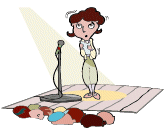
You could, perhaps arrange a trip to a natural history museum where stationery spiders are on display and progress to a wildlife centre where you can watch spiders (under glass), as they move about.


The next stage has to be the imaginary scene where you relax and think about a spider harmlessly scuttling around. When you are comfortable about this you can imagine picking one up or placing a glass over the spider and sliding a piece of card underneath it to rescue it and place it in a safe place outdoors.


As you progress you will finally expose yourself to a spider (by expose, I don’t mean that you’ll strip off, of course) – and will be able to pick one up, using either of the imagined methods you’ve previously visualized.


Adapting the Method


The same principle would apply to someone suffering from, for example, a fear of flying or a fear of heights.


You could begin by looking at photographs or pictures of airplanes or a view from a very high building and gradually progress to watching a film of the same object or situation to imagining flying on an airplane or being in a tall building or on a long flight of steps or an escalator (whatever the worst scenario was).


Note: Desensitization when used in conjunction with psychological treatment doesn’t usually involve exposing oneself to the phobic stimuli in one session – it can take place over a number of weeks or even months.

Flooding


As the name suggests, flooding means being subjected the maximum exposure of the phobic stimuli in order to produce the conditioned response and dissipate any fear. This could be carried out with someone who had a fear of crowds, for example. They may be accompanied by a ‘helper’ who would stay at a comfortable to reassure the sufferer if need be.


Once it was realized that nothing awful was going to happen the fear should subside and the sufferer realizes that the fear is groundless. Likewise, our fear of spiders subject could be given maximum exposure to a roomful of jour eight legged friends until she realizes that she is safe and in control of the situation.


NLP


Practitioners of NLP use specific language patterns that communicate unconsciously to the subject. One of their main tenets of thought is that no-one is broken – we all have the internal resources to help ourselves.


A Fast Phobic Release program might involve the subject being asked to imagine the spider as looking quite ridiculous, for example, wearing a big hat and sunglasses, hobbling around on one leg and holding onto the rest, or carrying crutches. This method brings humour into the situation and helps to release the fear.

Another method might be to have the victim imagine the spider on a screen and turn down the brightness, size and intensity of the image, have it float up into the corner of the screen and project a more positive image into the centre. They would then use a ‘swish’ technique to replace any further images of spiders to the more desired one.


Hypnosis


Hypnotherapists use different approaches to eliminating phobic responses. One method, known as Suggestion Therapy would be similar to the NLP method, by hypnotizing the subject into a relaxed state and offering suggestions to the subconscious mind that they are totally comfortable in whatever the phobic situation is.

For example, someone with a fear of flying could be directed to find a ‘safe place’ before embarking on a flight. Knowing they can return to this safe place at any time, they would be taken on an imaginary journey, commencing with purchasing the tickets for a holiday abroad, imagining themselves at home preparing for the journey, arriving at the airport, embarking the plane and eventually flying and feeling comfortable about it.


If at any time, an signs of anxiety were apparent, the subject can be taken back to the safe place.

Regression

This method aims to remove the original cause of the anxiety by taking the subject back to when the anxiety was initially felt.

One method is to use an ‘Affect Bridge’ whereby the subject is instructed to remember the last time she experienced such fear and trace it back the initial event. Another method would involve setting up signals with subject’s subconscious mind and asking questions about when the fear was first experienced, taking them back to that original event and reframing it or reassuring the subject.


Example


An elderly lady had been afraid of flying for most of her life. Questioning her subconscious mind during hypnosis, revealed that this was not entirely her own fear, but had begun when she saw a photograph of her father, who himself suffered from a fear of flying, having a panic attack on an airplane. This had affected her so much that she ‘inherited’ her father’s fear and made it her own. It was not until, many years later, when this lady was able to see cause of her fear, she was able to release it.


Self Hypnosis and Affirmations


The easiest way to learn self hypnosis is to be hypnotized and receive a post hypnotic suggestion that you will be able to enter the hypnotic state at a given signal. This involves going into a trance state and giving yourself affirmations in the present tense, for example – I feel comfortable in the presence of strangers, I remain calm and relaxed whenever I see a spider, and so on.


The Affirmation can itself be turned into a symbol which the subject focuses on whilst inducing self hypnosis. This method involves creating a nonsense symbol (something he or she will not consciously recognize), perhaps made through writing a sentence on the desired outcome and eliminating all repeated letters and vowels, then combining them into an image of sorts. Because the symbol is illogical the subconscious mind can accept the meaning behind it without interference from the conscious, thinking mind.


psychologistworld


Posted in News & updates | Leave a comment

A Guide to Overcoming Phobias

In this phobias guide:

Experienced hypnotherapist Faith Waude DHP has treated thousands of people for issues such as fears and phobias. Writing exclusively for Psychologist World, Faith takes us through the psychological techniques you can employ to self-help yourself to overcome those fears forever…

First, to define a phobia…

There are literally thousands of different kinds of phobia; practically all of them have been given names, ranging from Agoraphobia (fear of open spaces) to Xenophobia. (Fear of strangers or foreigners), it would take a whole volume to even attempt to list them all.

A Roman writer named Celsius first used the word phobia to describe ‘morbid fears’ and since then that name has stuck, even being used by William Shakespeare.

Many people have phobias without even realizing it – people who blush furiously when facing a situation where they feel they are being looked at, probably have no idea that they are suffering from scopophobia (a fear of being stared at) whilst another person who is actually afraid of blushing could be said to have ereuthophobia (a fear of blushing).

Queen Elizabeth I had a fear of having a rose anywhere near her, but it is doubtful that she’d ever heard of the term anthophobia and King Edward VII’s fear of the number thirteen affected him so much that he could not bear to be at a table where there were thirteen people present.

Although each phobia is given a different name and all seem unique to the person suffering this extreme fear, they are actually a symbolic outward expression of internal anxiety – a free floating, nameless, formless thing that is within themselves but outside of their own control.

This free floating anxiety attaches itself to something within the individual’s environment in order for them to make sense of it. It is far easier to attach an anxiety to, for example, a fear of spiders, than it is to try to understand what these internal conflicts represent and to then deal with them. In a way, phobias are more common in intelligent people as it takes a degree of intellect for a person to project these free floating anxieties outside him or herself.

The gain to the intellect is that it is far easier to project these unwanted feelings onto something that they can understand and so avoid, rather than try to work out what it is that is causing the anxiety.

Should the sufferer avoid whatever it is that represents his phobia (e.g. thunderstorms) and still feel bouts of anxiety, then his phobia will escalate at an alarming rate and he or she could develop numerous other fears and phobias, such as fear of electricity, fear of sudden, loud noises, fear of leaving the home, etc. until he or she has a long list of phobias.

Physical Symptoms:

Symptoms that appear physiological often develop out of the unexplored anxieties and can range from stomach ulcers, migraines, irritable bowel syndrome, rashes, to stuttering, blushing, warts, impaired memory, palpitations – the list is endless.


If a persona suffering from a stomach ulcer was taken into hospital and operated upon, their stomach ulcer might disappear and they would be proclaimed as fit and healthy again. However, if that menacing, free-floating anxiety was still lying dormant within the person’s subconscious mind, chances are that they would later develop a different symptom. The mind carries it’s memory traces and patterns and these are likely to be repeated if the cause of the anxiety or phobia is not revealed and dealt with.


Anxiety and Panic Attacks


A person who is confronted with the symbolic situation or object of his phobia could suffer a variety of symptoms depending on the degree of anxiety felt. The most common ones are: palpitations, sweaty hands or back of the neck, racing heart, pounding head, tremors, breathlessness, fainting, constricted muscles, light-headedness and shaking – quite often the person suffering the attack feels rooted to the spot.


The first time an anxiety attack is experienced it usually seems to happen for no apparent reason, therefore, the subject cannot rationally explain it to himself ad it is literally a ‘fear of the unknown’.


Once the panic attack is over, the subject returns to normal, realizing that no harm has really been done. However, because it cannot be satisfactorily explained, the sufferer never knows when it is going to recur – it has been likened to living next door to a volcano – that could erupt at any time.


In fact the victim of the panic attack is subsequently watching and waiting for the next onset, so much so that, when it does happen again, it erupts with a vengeance, increasing the level of anxiety to an alarming degree. This leads to a ‘vicious cycle’ of the mind affecting the body and the body counteracting by affecting the mind’ until the whole pent up emotion is discharged and the energy dissipated.

psychologistworld


Posted in News & updates | Leave a comment

How Quickly do our Short-Term Memories Decay?

Study by Peterson & Peterson (1959) of how quickly we forget memories.

Peterson and Peterson investigated one of the factors that causes our short-term memory to decay, i.e. why we forget information in our short-term memory. In 1959, they conducted an experiment that revealed how time between remembering something and having to recall it affected the life of a memory.

Procedure
What is at Trigram, and why use it?

Peterson and Peterson showed participants a trigram – a set of 3 consonant letters, such as ADW. This method would be known as the Brown-Peterson technique, and can be used to remove a number of factors that might affect someone’s memorization of a piece of information:

1) The trigram has little or no meaning, unlike asking a person to remember a word which they may associate with something and be able to remember better.

2) There are no vowels in the trigram, preventing any easy pronunciation of the trigram as a word, which makes it more difficult to remember on any other basis than as a trigram.

3) Unlike words, the trigrams are equal in length, making the experiment less biased in terms of the information it requires participants to remember.

In the experiment:

  1. Participants were asked to remember a trigram (see right).
  2. Next, they were given a delay between recall in which they were required to perform an interference task, which would reduce the chances of them using techniques to rehearse the data and remember it better. The delay between being shown the trigram and asked to recall it varied between participants – one of the following intervals: 3, 6, 9, 12, 15 or 18 seconds.
  3. Participants tried to recall the trigram.
Findings

Recall success was around 50% after an interval of 3 seconds and interference task, but this reduced gradually to around 10% over intervals of 6, 9 and 12 seconds, and gradually to around 5% success after 18 seconds.

This suggests that time does indeed result in decay in the short-term memory.

Evaluation of the Experiment

Peterson and Peterson were careful to eliminate factors other than time that might affect recall:

Interference tasks reduced the chances of rehearsal before recall.

In addition to this trigrams were used to eliminate the attached meaning that might be used to remember, for example, words, better.
Lacks ecological validity – how often is a person needed to remember trigrams in reality?
Posted in News & updates | Leave a comment

Dream Interpretation: Why Do We Dream? section    

The brain receives stimuli from many different sources
all day long. There are far too many stimuli for it to
process. The mind prioritizes the stimuli and makes you
aware of those that need immediate attention (the crying
baby, the out-of-control car, your boss’ request) so that you
may act accordingly.

The stimuli that you are not consciously aware of are
nevertheless noted by the brain, but on a subconscious level
(the drip of the bathroom water faucet, the remark by a
coworker at the water cooler while you were on the
telephone.)

Furthermore, you feel emotions all day. Some you
acknowledge and act on (you say thank you and smile when
you are complimented.) Some you repress or do not allow
yourself to act on (you don’t punch your boss in the nose
when he tells you the report you worked on for a week is no
longer needed.)

Traumatic experiences occur that you face (you call the
police) or if it too painful, you deny them happening and
send them deep into your subconscious (repression.)

In addition to all these emotions and stimuli the brain
must process daily, it also keeps your body functioning; it
remembers names and faces; it allows you to talk and walk
and chew gum (sometimes all at the same time); and
performs numerous other activities that you take for
granted.

You must admit — that’s a lot to do. At night, when
your body must rest, the mind continues working. When no
longer called upon to type letters and do the grocery
shopping, the brain concentrates on processing all of those
subconscious stimuli and emotions (while still maintaining
body temperature and breathing, etc.)

This is why we dream. Only you are not awake to
receive the signals at a conscious level — you can not hear
or see or touch (at a conscious level) while you are sleeping.
The brain must resort to other means to get the signals
through to your conscious mind. This is why we dream the
way we do.

The mind uses everything at its disposal (which is
everything it has ever been exposed to) to get the message
across. Simply put, dreaming is the minds way of
processing all of the stimuli and emotions it has received
during the day or repressed over time, so that you may act
on them.

All in all, it’s a pretty neat system. But unless you are
remembering and making sense of your dreams, you are
missing out on countless opportunities to learn about
yourself and experience life to its fullest.

Even though we’ve addressed it before, it bears
repeating. Why should you try and remember your dreams?


psychologistworld

Posted in News & updates | Leave a comment