
A Guide to Overcoming Phobias: Treating

Treatments for Phobias and Panic

There are many different approaches to treating phobias and the resulting panic that follows and some will be more effective than others depending on the individual.

If you are suffering from a phobia then you could try any of the methods outlined to see which one works for you. Because there are so many different types of phobia, we’ll give you one specific example, followed by another one to see how you can adapt this method to suit yourself.


Desensitization


Let’s take an easy one first – a fear of spiders. To desensitize yourself you could begin by finding a photograph or a picture of a spider and focusing on it for a few seconds, gradually building up to looking a the picture for five or more minutes.
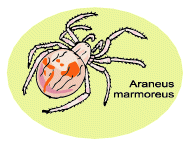
 

When you feel comfortable with this, the next stage is to watch a film or a video (perhaps a nature program) with spiders in.

You could, perhaps arrange a trip to a natural history museum where stationery spiders are on display and progress to a wildlife centre where you can watch spiders (under glass), as they move about.


The next stage has to be the imaginary scene where you relax and think about a spider harmlessly scuttling around. When you are comfortable about this you can imagine picking one up or placing a glass over the spider and sliding a piece of card underneath it to rescue it and place it in a safe place outdoors.


As you progress you will finally expose yourself to a spider (by expose, I don’t mean that you’ll strip off, of course) – and will be able to pick one up, using either of the imagined methods you’ve previously visualized.


Adapting the Method


The same principle would apply to someone suffering from, for example, a fear of flying or a fear of heights.


You could begin by looking at photographs or pictures of airplanes or a view from a very high building and gradually progress to watching a film of the same object or situation to imagining flying on an airplane or being in a tall building or on a long flight of steps or an escalator (whatever the worst scenario was).


Note: Desensitization when used in conjunction with psychological treatment doesn’t usually involve exposing oneself to the phobic stimuli in one session – it can take place over a number of weeks or even months.

Flooding


As the name suggests, flooding means being subjected the maximum exposure of the phobic stimuli in order to produce the conditioned response and dissipate any fear. This could be carried out with someone who had a fear of crowds, for example. They may be accompanied by a ‘helper’ who would stay at a comfortable to reassure the sufferer if need be.


Once it was realized that nothing awful was going to happen the fear should subside and the sufferer realizes that the fear is groundless. Likewise, our fear of spiders subject could be given maximum exposure to a roomful of jour eight legged friends until she realizes that she is safe and in control of the situation.


NLP


Practitioners of NLP use specific language patterns that communicate unconsciously to the subject. One of their main tenets of thought is that no-one is broken – we all have the internal resources to help ourselves.


A Fast Phobic Release program might involve the subject being asked to imagine the spider as looking quite ridiculous, for example, wearing a big hat and sunglasses, hobbling around on one leg and holding onto the rest, or carrying crutches. This method brings humour into the situation and helps to release the fear.

Another method might be to have the victim imagine the spider on a screen and turn down the brightness, size and intensity of the image, have it float up into the corner of the screen and project a more positive image into the centre. They would then use a ‘swish’ technique to replace any further images of spiders to the more desired one.


Hypnosis


Hypnotherapists use different approaches to eliminating phobic responses. One method, known as Suggestion Therapy would be similar to the NLP method, by hypnotizing the subject into a relaxed state and offering suggestions to the subconscious mind that they are totally comfortable in whatever the phobic situation is.

For example, someone with a fear of flying could be directed to find a ‘safe place’ before embarking on a flight. Knowing they can return to this safe place at any time, they would be taken on an imaginary journey, commencing with purchasing the tickets for a holiday abroad, imagining themselves at home preparing for the journey, arriving at the airport, embarking the plane and eventually flying and feeling comfortable about it.


If at any time, an signs of anxiety were apparent, the subject can be taken back to the safe place.

Regression

This method aims to remove the original cause of the anxiety by taking the subject back to when the anxiety was initially felt.

One method is to use an ‘Affect Bridge’ whereby the subject is instructed to remember the last time she experienced such fear and trace it back the initial event. Another method would involve setting up signals with subject’s subconscious mind and asking questions about when the fear was first experienced, taking them back to that original event and reframing it or reassuring the subject.


Example


An elderly lady had been afraid of flying for most of her life. Questioning her subconscious mind during hypnosis, revealed that this was not entirely her own fear, but had begun when she saw a photograph of her father, who himself suffered from a fear of flying, having a panic attack on an airplane. This had affected her so much that she ‘inherited’ her father’s fear and made it her own. It was not until, many years later, when this lady was able to see cause of her fear, she was able to release it.


Self Hypnosis and Affirmations


The easiest way to learn self hypnosis is to be hypnotized and receive a post hypnotic suggestion that you will be able to enter the hypnotic state at a given signal. This involves going into a trance state and giving yourself affirmations in the present tense, for example – I feel comfortable in the presence of strangers, I remain calm and relaxed whenever I see a spider, and so on.


The Affirmation can itself be turned into a symbol which the subject focuses on whilst inducing self hypnosis. This method involves creating a nonsense symbol (something he or she will not consciously recognize), perhaps made through writing a sentence on the desired outcome and eliminating all repeated letters and vowels, then combining them into an image of sorts. Because the symbol is illogical the subconscious mind can accept the meaning behind it without interference from the conscious, thinking mind.


 

Posted in News & updates | Leave a comment

Depression Causes of Depression

Some types of depression run in families, suggesting that a biological vulnerability can be inherited. This seems to be the case with bipolar disorder. Studies of families in which members of each generation develop bipolar disorder found that those with the illness have a somewhat different genetic makeup than those who do not get ill. However, the reverse is not true: Not everybody with the genetic makeup that causes vulnerability to bipolar disorder will have the illness. Apparently additional factors, possibly stresses at home, work, or school, are involved in its onset.


In some families, major depression also seems to occur generation after generation. However, it can also occur in people who have no family history of depression. Whether inherited or not, major depressive disorder is often associated with changes in brain structures or brain function.


People who have low self-esteem, who consistently view themselves and the world with pessimism or who are readily overwhelmed by stress, are prone to depression. Whether this represents a psychological predisposition or an early form of the illness is not clear.


In recent years, researchers have shown that physical changes in the body can be accompanied by mental changes as well. Medical illnesses such as stroke, a heart attack, cancer, Parkinson’s disease, and hormonal disorders can cause depressive illness, making the sick person apathetic and unwilling to care for his or her physical needs, thus prolonging the recovery period. Also, a serious loss, difficult relationship, financial problem, or any stressful (unwelcome or even desired) change in life patterns can trigger a depressive episode. Very often, a combination of genetic, psychological, and environmental factors is involved in the onset of a depressive disorder. Later episodes of illness typically are precipitated by only mild stresses, or none at all.


Depression in Women

Women experience depression about twice as often as men.1 Many hormonal factors may contribute to the increased rate of depression in women�particularly such factors as menstrual cycle changes, pregnancy, miscarriage, postpartum period, pre-menopause, and menopause. Many women also face additional stresses such as responsibilities both at work and home, single parenthood, and caring for children and for aging parents.


A recent NIMH study showed that in the case of severe premenstrual syndrome (PMS), women with a preexisting vulnerability to PMS experienced relief from mood and physical symptoms when their sex hormones were suppressed. Shortly after the hormones were re-introduced, they again developed symptoms of PMS. Women without a history of PMS reported no effects of the hormonal manipulation.


Many women are also particularly vulnerable after the birth of a baby. The hormonal and physical changes, as well as the added responsibility of a new life, can be factors that lead to postpartum depression in some women. While transient “blues” are common in new mothers, a full-blown depressive episode is not a normal occurrence and requires active intervention. Treatment by a sympathetic physician and the family’s emotional support for the new mother are prime considerations in aiding her to recover her physical and mental well-being and her ability to care for and enjoy the infant.


Depression in Men


Although men are less likely to suffer from depression than women, 3 to 4 million men in the United States are affected by the illness. Men are less likely to admit to depression, and doctors are less likely to suspect it. The rate of suicide in men is four times that of women, though more women attempt it. In fact, after age 70, the rate of men’s suicide rises, reaching a peak after age 85.

Depression can also affect the physical health in men differently from women. A new study shows that, although depression is associated with an increased risk of coronary heart disease in both men and women, only men suffer a high death rate.


Men’s depression is often masked by alcohol or drugs, or by the socially acceptable habit of working excessively long hours. Depression typically shows up in men not as feeling hopeless and helpless, but as being irritable, angry, and discouraged; hence, depression may be difficult to recognize as such in men. Even if a man realizes that he is depressed, he may be less willing than a woman to seek help. Encouragement and support from concerned family members can make a difference. In the workplace, employee assistance professionals or worksite mental health programs can be of assistance in helping men understand and accept depression as a real illness that needs treatment.


Depression in the Elderly

Some people have the mistaken idea that it is normal for the elderly to feel depressed. On the contrary, most older people feel satisfied with their lives. Sometimes, though, when depression develops, it may be dismissed as a normal part of aging. Depression in the elderly, undiagnosed and untreated, causes needless suffering for the family and for the individual who could otherwise live a fruitful life. When he or she does go to the doctor, the symptoms described are usually physical, for the older person is often reluctant to discuss feelings of hopelessness, sadness, loss of interest in normally pleasurable activities, or extremely prolonged grief after a loss.


Recognizing how depressive symptoms in older people are often missed, many health care professionals are learning to identify and treat the underlying depression. They recognize that some symptoms may be side effects of medication the older person is taking for a physical problem, or they may be caused by a co-occurring illness. If a diagnosis of depression is made, treatment with medication and/or psychotherapy will help the depressed person return to a happier, more fulfilling life. Recent research suggests that brief psychotherapy (talk therapies that help a person in day-to-day relationships or in learning to counter the distorted negative thinking that commonly accompanies depression) is effective in reducing symptoms in short-term depression in older persons who are medically ill. Psychotherapy is also useful in older patients who cannot or will not take medication. Efficacy studies show that late-life depression can be treated with psychotherapy.


Improved recognition and treatment of depression in late life will make those years more enjoyable and fulfilling for the depressed elderly person, the family, and caretakers.


Depression in Children

Only in the past two decades has depression in children been taken very seriously. The depressed child may pretend to be sick, refuse to go to school, cling to a parent, or worry that the parent may die. Older children may sulk, get into trouble at school, be negative, grouchy, and feel misunderstood. Because normal behaviors vary from one childhood stage to another, it can be difficult to tell whether a child is just going through a temporary “phase” or is suffering from depression. Sometimes the parents become worried about how the child’s behavior has changed, or a teacher mentions that “your child doesn’t seem to be himself.” In such a case, if a visit to the child’s pediatrician rules out physical symptoms, the doctor will probably suggest that the child be evaluated, preferably by a psychiatrist who specializes in the treatment of children. If treatment is needed, the doctor may suggest that another therapist, usually a social worker or a psychologist, provide therapy while the psychiatrist will oversee medication if it is needed. Parents should not be afraid to ask questions: What are the therapist’s qualifications? What kind of therapy will the child have? Will the family as a whole participate in therapy? Will my child’s therapy include an antidepressant? If so, what might the side effects be?


The National Institute of Mental Health (NIMH) has identified the use of medications for depression in children as an important area for research. The NIMH-supported Research Units on Pediatric Psychopharmacology (RUPPs) form a network of seven research sites where clinical studies on the effects of medications for mental disorders can be conducted in children and adolescents. Among the medications being studied are antidepressants, some of which have been found to be effective in treating children with depression, if properly monitored by the child’s physician.

Posted in News & updates | Leave a comment

Depression

What are depressive disorders?

A depressive disorder is an illness that involves the body, mood, and thoughts. It affects the way a person eats and sleeps, the way one feels about oneself, and the way one thinks about things. A depressive disorder is not the same as a passing blue mood. It is not a sign of personal weakness or a condition that can be willed or wished away. People with a depressive illness cannot merely “pull themselves together” and get better. Without treatment, symptoms can last for weeks, months, or years. Appropriate treatment, however, can help most people who suffer from depression.


TYPES OF DEPRESSION

Depressive disorders come in different forms, just as is the case with other illnesses such as heart disease. This pamphlet briefly describes three of the most common types of depressive disorders. However, within these types there are variations in the number of symptoms, their severity, and persistence.


Major depression is manifested by a combination of symptoms (see symptom list) that interfere with the ability to work, study, sleep, eat, and enjoy once pleasurable activities. Such a disabling episode of depression may occur only once but more commonly occurs several times in a lifetime.


A less severe type of depression, dysthymia, involves long-term, chronic symptoms that do not disable, but keep one from functioning well or from feeling good. Many people with dysthymia also experience major depressive episodes at some time in their lives.


Another type of depression is bipolar disorder, also called manic-depressive illness. Not nearly as prevalent as other forms of depressive disorders, bipolar disorder is characterized by cycling mood changes: severe highs (mania) and lows (depression). Sometimes the mood switches are dramatic and rapid, but most often they are gradual. When in the depressed cycle, an individual can have any or all of the symptoms of a depressive disorder. When in the manic cycle, the individual may be overactive, overtalkative, and have a great deal of energy. Mania often affects thinking, judgment, and social behavior in ways that cause serious problems and embarrassment. For example, the individual in a manic phase may feel elated, full of grand schemes that might range from unwise business decisions to romantic sprees. Mania, left untreated, may worsen to a psychotic state.


SYMPTOMS OF DEPRESSION AND MANIA

Not everyone who is depressed or manic experiences every symptom. Some people experience a few symptoms, some many. Severity of symptoms varies with individuals and also varies over time.


Depression
  • Persistent sad, anxious, or “empty” mood
  • Feelings of hopelessness, pessimism
  • Feelings of guilt, worthlessness, helplessness
  • Loss of interest or pleasure in hobbies and activities that were once enjoyed, including sex
  • Decreased energy, fatigue, being “slowed down”
  • Difficulty concentrating, remembering, making decisions
  • Insomnia, early-morning awakening, or oversleeping
  • Appetite and/or weight loss or overeating and weight gain
  • Thoughts of death or suicide; suicide attempts
  • Restlessness, irritability
  • Persistent physical symptoms that do not respond to treatment, such as headaches, digestive disorders, and chronic pain
Mania
  • Abnormal or excessive elation
  • Unusual irritability
  • Decreased need for sleep
  • Grandiose notions
  • Increased talking
  • Racing thoughts
  • Increased sexual desire
  • Markedly increased energy
  • Poor judgment
  • Inappropriate social behavior
Posted in News & updates | Leave a comment

Depression An Introduction

In any given 1-year period, 9.5 percent of the population, or about 18.8 million American adults, suffer from a depressive illness5 The economic cost for this disorder is high, but the cost in human suffering cannot be estimated. Depressive illnesses often interfere with normal functioning and cause pain and suffering not only to those who have a disorder, but also to those who care about them. Serious depression can destroy family life as well as the life of the ill person. But much of this suffering is unnecessary.


Most people with a depressive illness do not seek treatment, although the great majority�even those whose depression is extremely severe�can be helped. Thanks to years of fruitful research, there are now medications and psychosocial therapies such as cognitive/behavioral, “talk” or interpersonal that ease the pain of depression.


Unfortunately, many people do not recognize that depression is a treatable illness. If you feel that you or someone you care about is one of the many undiagnosed depressed people in this country, the information presented here may help you take the steps that may save your own or someone else’s life.

Posted in News & updates | Leave a comment

Agoraphobia

Agoraphobia is a form of anxiety disorder. The name is literally translated as “a fear of the marketplace”, from the Greek agora, and thus of open or public spaces. Many people suffering from agoraphobia, however, are not afraid of the open spaces themselves, but of situations often associated with these spaces, such as social gatherings. Others are comfortable seeing visitors, but only in a defined space they feel in control of–such a person may live for years without leaving his home, while happily seeing visitors and working, as long as they can stay within their safety zone.


An agoraphobic experiences severe panic attacks during situations where they feel trapped, insecure, out of control, or too far from their personal comfort zone. During severe bouts of anxiety, the agoraphobic is confined not only to their home, but to one or two rooms and they may even become bedbound until their over-stimulated nervous system can quieten down, and their adrenaline levels return to a more normal level.


Agoraphobics are often extremely sensitised to their own bodily sensations, sub-consciously over-reacting to perfectly normal events. To take one example, the exertion involved in climbing a flight of stairs may be the cause for a fullblown panic attack, because it increases the heartbeat and breathing rate, which the agoraphobic interprets as the start of a panic attack instead of a normal fluctuation.


Agoraphobia can be successfully treated in many cases through a very gradual process of graduated exposure therapy combined with cognitive therapy and sometimes anti-anxiety or antidepressant medications.

Overcome Agoraphobia with a Hypnosis Download. Click here

Adapted from: http://en.wikipedia.org/wiki/Agoraphobia

Posted in News & updates | Leave a comment