
Addicted to Stress? Surrender and Go With the Flow

By Judith Orloff, MD, Special to Everyday Health

There’s a telling detail in the latest “Stress in America” survey from the American Psychological Association. About half of the respondents (48 percent) reported being regularly stressed out because they are “unable to control the important things in their life very or fairly often.”

While many of us believe trying to control outcomes in our life will take away the stress of uncertainty, in fact, the opposite is true. Trying to control the outcome or make things happen the way you want them to is what causes stress, not what relieves it.

This simple concept is so important to health and happiness that I wrote an entire book on the subject. In The Ecstasy of Surrender, I explain all the ways we’re addicted to stress in our lives – whether it’s by overworking, overindulging, overspending, being in unhealthy relationships, or doing many other things. There’s a simple solution, and it’s learning how to let go of control.

Surrendering our need to be in control helps us relax, get in the flow, and be flexible. When we learn to surrender, everything gets easier, from how we deal with our finances, to how we heal from illness. Surrender opens us up to intuition, serendipity, and unexpected gifts. It enables us to get what we really need and want in life – but without stressing about it or trying so hard.

So let’s look at some ways to stop being addicted to stress.

Letting Go of Power-Related Stress

The problem: Being addicted to power causes undue stress in our lives. We try to control difficult people, we believe we need to do everything ourselves, or we micromanage others – such as a spouse who wants to share in vacation planning. In the workplace, we will go to any lengths to get to the top of the pecking order. We are driven and aggressive.

The solution: Practice intellectual surrender. That is, tell yourself that by letting go of knee-jerk reactions to challenging people, by stepping aside and allowing others to exercise their power, and by letting up on your relentless pursuit of goal achievement, you will be more relaxed and rested, and your relationships will be stronger. Letting go of the need for status will actually make you more influential at work and in your personal life.

Letting Go of Money Stress

The problem: Money is an enormous source of stress. We fret over whether we have enough to take care of our health, our bills, and our family. We imbue money with the power to make us happy, to buy friends or influence, and to “be somebody.”

The solution: Surrender your illusions about money. Money may spark envy, but it won’t help you be admired. The drive to make and spend more money isn’t worth the stress it creates, and will leave you exhausted. Use affirmations, such as “I surrender the illusion that money defines my self-worth.” Recognize money as a mirror. For example, do you appreciate what you have, or fear not having enough? Do you have gratitude or shame about your job? Are you charitable or greedy? See what values emerge, and focus on what you are grateful for in your life, rather than comparing yourself with others.

Letting Go of Time and Schedule Stress

The problem: We live in a culture that values goal achievement. As a result, we rush around trying to get as much accomplished as we can. The problem is, when we focus on the future – to-do lists and deadlines – we become anxious and stressed out.

The solution: It’s futile to worry about something that hasn’t happened, because we have no control over the future. Look to nature for great lessons about letting things happen at their own pace, and surrendering to the flow of life. When you experience worry, fear, or anxiety about an upcoming event or work deadline, gaze up at the sky and focus on a cloud. Watch it drift, and see what the shape reveals. This is a calming exercise that helps a rushing mind slow down and gain perspective. Also, take pride in every accomplishment, no matter how small or mundane. Success doesn’t hinge on how much you get done, but rather the clarity you bring to each task.

Letting Go of Relationship Stress

The problem: Relationship stress comes from being attracted to unavailable people – those who are emotionally shut down, self-destructive, or dishonest, for example. When we try to connect, we get frustrated. Another source of stress comes from surrounding ourselves with emotional vampires – people who drain us by being needy, angry, passive-aggressive, or egotistical.

The solution: Take a hard look at the people in your life, from your love relationships and family members to your friends and professional colleagues. Do you feel energized after seeing them, or stressed-out and depleted? Find ways to politely but firmly say no and to separate yourself from people who create more stress in your life, rather than relieve it. Surrender your need to rescue others or constantly take care of their needs.

Judith Orloff, MD, is author of a new book, The Ecstasy of Surrender: 12 Surprising Ways Letting Go Can Empower Your Life. An Assistant Clinical Professor of Psychiatry at UCLA and a New York Times bestselling author, Dr. Orloff teaches workshops nationwide, has given a TED talk on this book, and has appeared on The Dr. Oz Show, Today, PBS, CNN, NPR, and many others.

Posted in Coping mechanisms | Leave a comment

Understanding the ‘Rollercoaster’ Known as Bipolar Disorder

Millions of Americans have the mood disorder, yet it is often misunderstood and misdiagnosed.

Indiscriminate. Wild. Exhausting. That’s how Brad Shreve describes bipolar disorder, a mental illness that causes dramatic shifts in mood and energy. Millions of Americans like Shreve have this chronic condition, which can disrupt lives, damage relationships, and make even routine tasks a challenge.

Bipolar disorder, also known as manic depression, is characterized by extreme energy and profound euphoria or mania alternating with bouts of depression – something Shreve describes as a “rollercoaster” on his blog.

The symptoms of a manic episode may include an elated mood, irritability, insomnia, and impulsivity. Depressive episodes are characterized by feelings of sadness and hopelessness, social isolation, and a loss of interest in activities that were once enjoyable. These cycles of high and low moods follow irregular patterns, and mood episodes may mix symptoms of mania and depression.

“When [the depression] hits, I shut the blinds. I don’t shower, shave, or clean up. I don’t go outside,” Shreve says. Other times, “I want to do everything at once…but in the end I get nothing done because it goes way beyond what one person can do in a day.”

Men and women are equally affected by bipolar disorder. According to the National Alliance on Mental Illness (NAMI), more than half of all cases start between 15 and 25 years of age, though symptoms can appear in younger children or later in life.

There are different categories of bipolar disorder, based on symptom patterns and intensity. As defined in the American Psychiatric Association’s Diagnostic and Statistical Manual of Mental Disorders, types of bipolar disorder include:

Bipolar I consists of manic episodes lasting at least a week and major depressive episodes lasting two weeks or more.

Bipolar II is characterized by milder hypomanic episodes, which are less severe than manic ones, and periods of depression that are usually more frequent and last longer than those that occur in bipolar I.

Cyclothymic disorder or cyclothymia is a milder form of bipolar disorder with periods of hypomanic and depressive symptoms. “It can turn into bipolar I or bipolar II,” says Melissa DelBello, MD, co-medical director of the Mood Disorders Center at the University of Cincinnati Medical Center. “It depends on the degree of functional impairment.”

There is no lab test for bipolar disorder, so diagnosis is based on a patient’s physical examination, medical history, and psychological evaluation. Bipolar disorder is frequently misdiagnosed because its symptoms overlap with other illnesses. Shreve, for instance, was incorrectly diagnosed with depression for most of his life. In many cases, a person with bipolar disease may not realize they have a problem or refuse to see a doctor, which delays treatment and can result in serious physical, emotional, and personal problems.

The exact cause of bipolar disorder is unclear, though it’s most likely a combination of factors. “We know it’s genetic because it runs in families, but environmental stressors can precipitate its onset,” according to DelBello. Studies suggest that differences in brain structure and an imbalance of brain chemicals known as neurotransmitters play a role.

Certain triggers such as stress, lack of sleep, and substance abuse can set off a manic or depressive episode. Shreve recognizes that his depression is sometimes brought on by feeling overwhelmed. “If I have a busy day, it’s the next day that I really crash,” he says. “If I go to a party or work with people on a project, it can set it off because it’s more than I can handle.”

While bipolar disorder is not curable, its symptoms can be treated with medication and psychotherapy. David Miklowitz, PhD, director of the child and adolescent mood disorders program at the UCLA Semel Institute for Neuroscience and Human Behavior, stresses the importance of involving loved ones in a patient’s treatment.

“It’s helpful to bring family members into therapy and educate them about what bipolar is, how do you cope with it as a family, how do you recognize it as being out of hand, what’s effective communication in this context and what isn’t,” he says. “In these family therapy programs, if given with medication, the patients tend to do much better.”

Connecting with others who are living with bipolar disorder can provide emotional support and access to practical information and resources. NAMI and theDepression and Bipolar Support Alliance offer education programs as well as online and in-person support groups.

“Many people go on to live very successful lives with bipolar disorder,” DelBello says. “If you stay on your medication, monitor yourself for stressors, maintain a normal sleep pattern, and stay away from drugs and alcohol, it’s very possible.”

Posted in News & updates | Leave a comment

Temporary Break


HI ALL I am trying to devote more time to the support group there I do send out articles weekly two to four or every day like I do here. IT also has a full discussion board as I stated before for all mental health and wellness matters as well as daily charts to go by for mood anxiety symptoms and defined charts. We have a chat box we use mostly Tuesdays and Thursdays 12:00 PM – 2:00 pm Eastern time zone. We pretty much just opened but I have been running g groups for the past nine years or so. Everyone is treated with respect there are no c!icks tolerated. What do you have to lose take a chance many have said inc!using myself get much gratification in supporting others especially those who don’t have a voice yet.

Communicating, sharing, and connecting with others in a community will have a positive effect on healing in your life…. If you have been diagnosed with any Mental Health Disorder we Welcome you to this peer support group. We offer you to give and gain peer support through your journey of symptoms. triggers, treatment, and recovery.
The Support Team JanSupport
@

http://www.mentalhealthsupportcommunity.com

free life time membership no donations required. Hope to see you there I am at this time running campaigns and Ads to draw more attention my objective is to grow and supply you with the knowledge and support you and we all deserve. Have a good day. Sincerely


Jan


Posted in News & updates | Leave a comment

Embracing Living: The Welcoming Prayer October 3 – October 28, 2016

You are welcome to sign up for this e-course any time before the last day, October 28. After you do, you will find in your account an archive of the sessions covered so far, and you can read them online or resend them to yourself.

The Welcoming Prayer is a method of consenting to God’s presence and action in our physical and emotional reactions to events and situations in daily life. If Centering Prayer (or another daily prayer) is practiced for one hour of the day, the Welcoming Prayer is for the other 23 hours. It is a “letting go” in the present moment, in the midst of the activity of ordinary life. It helps to dismantle the emotional programs of the false-self system and to heal the wounds of a lifetime by addressing them where they are stored — in the body.

Practicing the Welcoming Prayer offers us the opportunity to make choices free of the false-self system — responding instead of reacting to the present moment. Through the action of the Holy Spirit, the practice empowers us to take appropriate action as freely and lovingly as possible in any situation that presents itself.

“To welcome and to let go
is one of the most
radically loving, faith-filled
gestures we can make
in each moment of each day.
It is an open-hearted embrace
of all that is in ourselves
and in the world.”
— Mary Mrozowski, creator of the Welcoming Prayer

Contemplative Outreach, founded by Fr. Thomas Keating and best known for its pioneering teaching of Centering Prayer, has developed a workshop on the contemplative practice of welcoming. Those who have faithfully been traveling with us each year will be happy to know that this retreat includes all new video teachings. You can look forward to these components:

– 12 emails that give the core teachings and practices.
– Four new videos, covering:
1. The Human Condition
2. The Method of the Welcoming Prayer
3. Nuances and Practice
4. Fruits of the Prayer
– Step-by-step instructions on the Welcoming Prayer, plus an audio version of the prayer to assist your practice.
– A one-hour teleconference on Thursday, October 13 (8-9 pm Eastern Time) with the e-course leaders from Contemplative Outreach.
– A recording of the teleconference for review or for listening if you cannot attend the live call.
– Mini-practices to root the Welcoming Prayer in your daily life.

Join us to learn or to deepen or renew this practical and profound prayer. The more we experience the Welcoming Prayer, the more we realize that we need to do the Welcoming Prayer. We learn the Welcoming Prayer through repeated courses, through the deepening of our understanding of the prayer. As we continue to consent, we open to God’s healing on ever-deepening levels.

Posted in News & updates | Leave a comment

How Dreams Become Goals

It is wonderful to have a dream. It can also be wonderful to have a goal.

True, there is a school of thought that maintains we should not need goals. We looked at this view a few months ago.

My own perception of this viewpoint is that it applies to those goal-lists that time management folks advocate. They can be useful, or a burden, depending on where you are in your personal growth. Today, though, I am looking at something different.

Today I am looking at the difference between having a dream and having a goal.

A dream is a goal without legs. It is a wonderful thing to have, can be the guiding passion of your life, but unless you clarify it and give it the legs to move toward you, getting there is going to be very much a matter of luck.

To transform a dream into a reachable goal you must clarify it, provide the details, make it so clear that you can see it, feel it, know what you will feel like when you get there. This works for you in many ways.

*It clarifies what you want to the point that you will always be attuned to anything that is relevant.
Opportunities will not pass you by unnoticed.

*It shows you what you need to do to get there, step by action step.

*It makes false detours and dead ends less likely to distract you.

*And perhaps the images you carry in your mind and heart will echo out to the universe for manifestation.

The clearer and more vivid the image, the more likely are all of these things to happen.

As an illustration, I will use a dream someone might have regarding a career, but the principle remains the same whatever the nature of your dream.

Let’s suppose that you yearn to work outdoors and close to nature. Someone asks you to tell them more, but you can’t. You don’t know. All you know is that you want to work outdoors and close to nature. This is a dream. Why is it not a goal? Because it is not specific. That description could fit many occupations, including park ranger, beach bum, safari tour guide, farmer, landscape gardener, migrant worker, beekeeper or many more.

There is a saying, “be careful what you pray for, because you will surely get it, but not necessarily in the form, and at the time, that you expected.” This applies particularly when your thoughts are not specific. Imagine putting out a prayer and a wish to the universe that you find a job that involves being in the outdoors and close to nature, and having your prayer answered by falling into a job as a beekeeper… when you are truly terrified of insects!

This is not bad luck, it is bad management. Bad management of your own desires and intentions. Both your own unconscious and the universe need clear direction before they can begin to manifest a path, let alone get results. If you are to harness your own energy and that of the universe so as to bring your dream into reality, you need first to create it in imagination.

Okay, let’s start again. You want a job working in the outdoors and close to nature. Buy yourself one of the many books on the subject of career choice that will help you to CLARIFY. Ask yourself those annoying questions that any career counselor would ask you.

What sort of work do you want to be doing? Do you like people? Do you like animals? What kind of animals? (There’s a big difference between working with a friendly kitty-cat and working with large wild animals who would prefer that you not be sharing their space.) Do you enjoy structure or freedom? And be careful of this one, because we all think we want freedom until we find ourselves working alone and without guidelines or supervision. For some people this works fine, for others it is far more threatening than they had realized.

For every image that comes to you, follow it, ask yourself how it fits, how you will work with it, and what comes next, until your dream is as vivid and enthralling as a five star movie. Know in your heart that this is what you want to be doing with your life, that it is a job you will enjoy so much that you’d love to do it even if you didn’t have to earn a living. Then put THAT image out there for manifestation. This time there will be no mistakes.

When I write “Put it out there for manifestation” I am not saying that you then sit back and wait. One of my mother’s sayings is “Pray as if it all depends on God, and then work as if it all depends on you.” It is good advice. But now, with your mental picture in place, you know what it is that you are working toward.

What you DON’T need to put out to the universe is exactly how this manifestation has to happen. If you do, then you are limiting the way in which you and your goal can come together. In truth there are more paths to your goal than you can imagine. It is fine to choose one that you will work on, with a couple of fall-backs in case of obstacles, but be careful to remain clear that these are not the only alternatives. Whatever it is that you seek, it may be manifested in ways beyond your
wildest dreams.

Posted in Coping mechanisms | Leave a comment

Think Big Positive Affirmations

Present Tense Affirmations
I always think big
I maximize success in all areas of my life
I aim high and push myself to the limit
I think big and go after my dreams
I dream huge and take huge action
I always take things to the next level and achieve massive success
I am someone who pushes limits and gets the most out of life
I pursue what I want in life with confidence and decisiveness
I am full of determination and because of that I always achieve my dreams
I always go after the highest possible level of success


Future Tense Affirmations
Each day I think bigger and bigger about my life
I get more out of life with each passing day
I am becoming someone that thinks big and takes decisive action
I am reaching higher and further each and every day
I am moving towards massive achievements
My hunger for big success is increasing
I am finding myself aiming higher and achieving more
I am turning into someone who never let’s up and is always driven
I am finding myself more intensely focused on achieving my dreams
I am becoming highly passionate about achieving my goals


Natural Affirmations
I naturally think big and aim high
I find it easy to stay motivated and achieve my dreams
I am always pushing success to the limit and getting the most out of my life
I am naturally driven to pursue big ideas and take big action
I am the kind of person who just never gives up
It’s normal for me to push limits and take things to the next level
I am naturally motivated to achieve my biggest dreams
I just think big and go after it, that’s how I live my life.
Being hungry for success is a normal part of my every day life
Staying focused on my goals is easy for me
Posted in Affirmations | Leave a comment

Organization Skills Positive Affirmations

Present Tense Affirmations
I am highly organized
I keep my work space tidy
I live a clutter free life
I am efficient and attentive
My mind is clear and focused
I always show up on time
Others see me as a reliable and organized person
I organize my mind and my life
My life is completely organized
I am totally organized, in control, and free from worry


Future Tense Affirmations
I am finding myself to be more organized each day
Organizational skills are changing my life for the better
I will keep my house tidy
I will live a clutter free life
I am beginning to manage my time much more efficiently
I am getting my entire life in order and on track
It is becoming easier to organize my life
I will organize my desk and get more work done
I am starting to see the benefits of being an organized person
Life is becoming so much easier now that I’m organized


Natural Affirmations
Being organized is easy
My ability to organize improves my productivity
Staying organized and on top of things makes my life run smoothly
I organize my life so that I can relax knowing everything is in order
I find it easy to keep my life organized
Being highly organized and efficient just the way I am
Organizing my time and maintaining control over my life comes naturally to me
Others know they can always count on me to be on time
I enjoy the feeling of having a tidy house
Consistent planning and organizing helps me to succeed
Posted in Affirmations | Leave a comment

Kenneth Cole Is Wrong About Mental Illness and Violence By Therese Borchard

American fashion designer Kenneth Cole recently posted a billboard prominently over Manhattan’s West Side Highway that reads, “Over 40M Americans suffer from mental illness. Some can access care … All can access guns.” The hashtags #GunReform and #AreYouPuttingUsOn were also included on the billboard.

Once again, an uneducated celebrity has used his influence to further stigmatize those with mental illness.

Link-Between-Mental-Illness-and-Violence-Is-Inaccurate-and-Unfair-722x406I fully expect him to be jumping on Oprah’s couch next week advising the public that if they embraced Scientology or possessed a pair of running shoes, there would be no need for psychiatric care.

American Psychiatric Association President Renee Binder, MD, made a public statement about the billboard, saying it unfairly linked mental illness with gun violence and the need for gun control. “It provides the gross misimpression that people with mental illness are violent,” Dr. Binder says. “The vast majority of people with mental illness are not violent, and most acts of violence are not committed by people with mental illness.”

But it’s difficult to ask Cole to revise his thinking when most Americans are right there with him. As psychology journalist Maria Konnikova explains in this New Yorker piece, the overwhelming majority of us still feel that most violent behavior is connected to mental illness. Konnikova writes:

As recently as 2013, almost 46 percent of respondents to a national survey said that people with mental illness were more dangerous than other people. According to two recent Gallup polls, from 2011 and 2013, more people believe that mass shootings result from a failure of the mental-health system than from easy access to guns. Eighty percent of the population believes that mental illness is at least partially to blame for such incidents.

Eighty percent.

If I’m paying attention, I hear about one inaccurate statement a day regarding violence and mental illness. Recently, after I wrote a post about the mistakes I made tapering off an antidepressant, I heard from a woman who was alarmed that I would discuss weaning off drugs, and therefore cause folks to do things like “shoot 20 people.”

Wow. Really?

As I said in another post, I’m DEPRESSED, not DANGEROUS.

There is a very definite difference.

Konnikova highlights the research of Jeffrey Swanson, PhD, a medical sociologist and professor of psychiatry at Duke University. About 25 years ago, he analyzed 10,000 individuals (both mentally ill and healthy) during the course of a year and found that, in only 4 PERCENT of violence cases, was the violence attributed to serious mental illness. Alcohol or drug abuse, and economic status, were much larger risk factors. Twelve years later, Dr. Swanson repeated his study, following 800 people in four states who were being treated for either psychosis or a major mood disorder. Thirteen percent of those people committed a violent act that year. But, as Konnikova explains, the other factors — namely unemployment, economic status, and drug and alcohol abuse — played a much bigger role. When you take awaythose factors, the risk for violence fell to a whopping 2 PERCENT. That is, THE SAME RISK AS FOUND IN THE GENERAL PUBLIC.

Swanson’s results are compatible with other studies that Konnikova cites. She writes:

subsequent study of over 1,000 discharged psychiatric inpatients, known as the MacArthur Violence Risk Assessment Study, found that, a year after their release, patients were only more likely than the average person to be violent if they were also abusing alcohol or drugs. Absent substance abuse, they were no more likely to act violently than were a set of randomly selected neighbors. Two years ago, an analysis of the National Epidemiologic Survey on Alcohol and Related Conditions (which contained data on more than 32,000 individuals) found that just under 3 percent of people suffering from severe mental illness had acted violently in the last year, as compared to just under 1 percent of the general population. Those who also abused alcohol or drugs were at an elevated 10 percent risk.

Kenneth Cole is a talented designer. I’ll give him that. But I think he could do more for those with mood disorders by showing them pretty pictures of boots and purses on his billboards than messages that suggest depressed people are to blame for the violence in this world.

We read that memo enough as it is.

Posted in News & updates | Leave a comment

TMS Offers an Alternative to Depression Drugs and Electroconvulsive Therapy

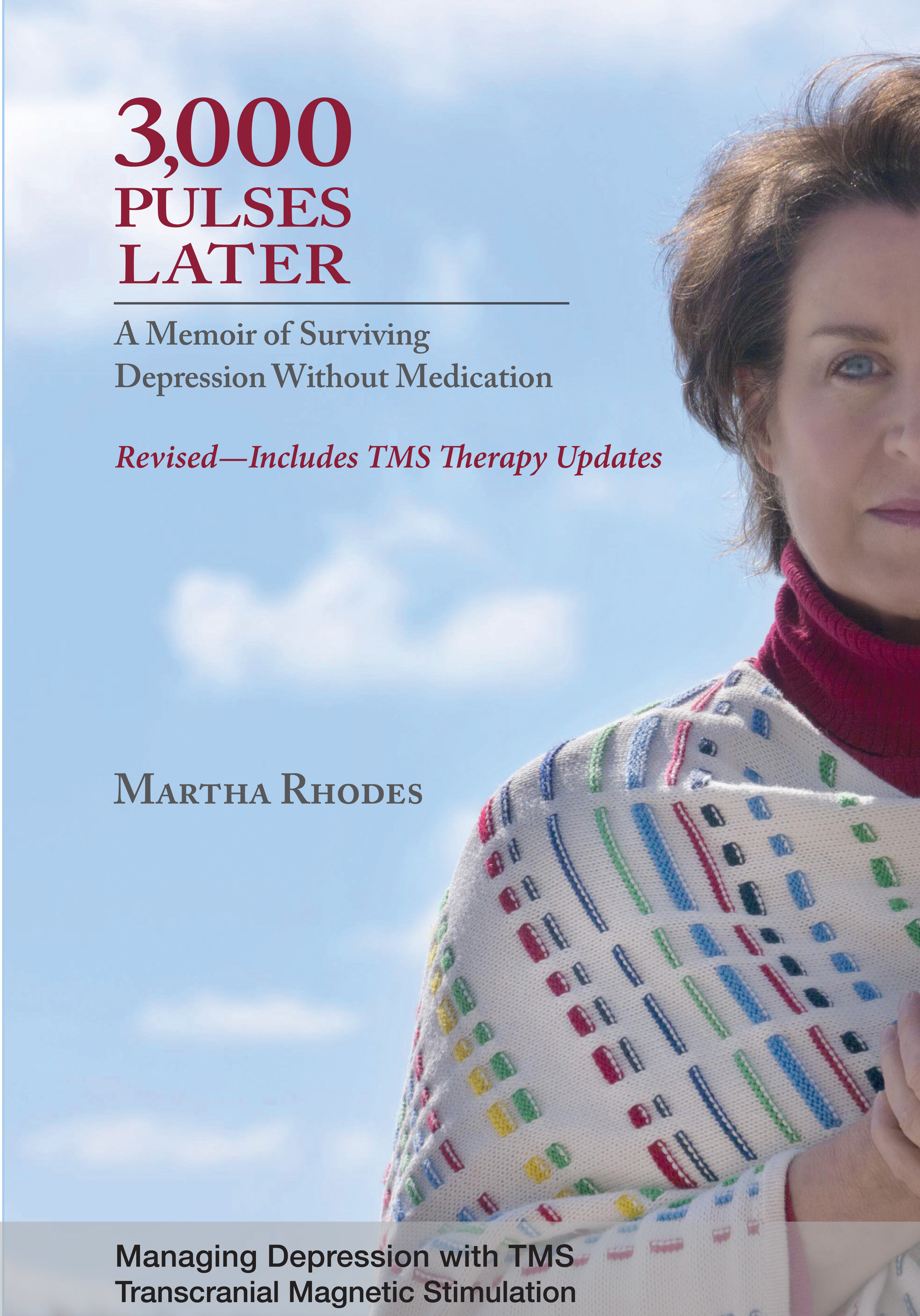
I haven’t read many paragraphs that articulate depression as accurately as this one, in Martha Rhodes’s riveting memoir, 3000 Pulses Later:

At that moment, my pain felt equal to — if not even more than — what I imagined any physical illness could pose. The constant anxiety, sadness, fear, and despair strangled me. I felt inexorably alone and as if I were dying a slow death of emotional asphyxiation. I may not have been diagnosed with incurable cancer of a vital organ, but I knew I was in the throes of battle with what felt like cancer of the soul.

It appears in her “Medication Merry-Go-Around” chapter right after she lists all the drugs that she’s tried, but which failed to give her any relief, including Zoloft (sertraline), Xanax (alprazolam), Lexapro (escitalopram), Paxil (paroxetine),venlafaxine (formerly sold as Effexor), Lamictal (lamotrigine),Concerta (methylphenidate), Topamax (topiramate), Seroquel (quetiapine), Klonopin (clonazepam), and Abilify (aripiprazole). A former advertising executive with a speck of sass, she finally confronts her psychiatrist.

“With all these different drugs I’ve been taking, why don’t I feel better?” she asks him. “Why aren’t they working after all this time?”

He explains that psychiatry is an art, not a science, to which she responds, “I am not your canvas, and you are not Rembrandt.”

Her feisty spirit is inspiring because it’s what ultimately leads her to health.

First, against all advice, she goes off her meds. She writes:3,000 Pulses Later_FINAL COVER FRONT_Repriint

My decision to stop taking all medications might be regarded as irrational, equal to the opposite — and extreme — action of overdosing on Xanax [which she did earlier], but I saw myself on a maddening merry-go-round with no bright and stately horses on which to ride. If my body could not tolerate the burdensome side effects of taking the drugs, drugs that hardly put a dent in my depressive symptoms, I meant to find out what my body could tolerate without them.

In retrospect, I see the enormous risk I took and would not recommend it to anyone. Sudden and total cessation of antidepressants, as is the case with many other medicines, can lead to catastrophic reverberations such as seizures. At the time, however, a persistent survival instinct trumped my confidence that antidepressants would do me any good. I had given up on psychiatrist appointments and the 10-minute medicine meet-ups. Mistrust, negativity, and unbounded frustration clouded any consideration to look for another doctor who might be a better caregiver. Other than continuing appointments with my talk therapist, I had essentially stranded myself on an island when I cut myself off from the traditional, well-traveled road of available drug treatment options.

Without any buoy to reach for, Martha is left horribly depressed and hopeless, drowning in the open sea. She considers electroconvulsive therapy (ECT), but can’t get past the possibility of memory loss. Then came her miracle, as she describes it, in the form of a magazine ad for transcranial magnetic stimulation (TMS), with the headline, “Treat Depression Without Medication.” TMS is a non-invasive procedure that stimulates nerve cells in the brain with short magnetic pulses. A large electromagnetic coil is placed against the scalp, which generates focused pulses that pass through the skull and stimulate the cerebral cortex of the brain, a region that regulates mood. The procedure was approved by the FDA in 2008.

Finally, after years of desperation, there was hope for Martha.

Her fight, however, was certainly not over. When she is declined by her health plan provider for TMS, but not for ECT, she invests a good chunk of her time into researching the benefits and costs of both treatments, comparing them for insurance purposes. She writes:

Although I know ECT is a viable and worthy therapy for patients who suffer with severe depression and need more relief than medications can provide, I have to acknowledge that at the time, for me, it seemed too invasive. It required general anesthesia with its inherent risks and had cognitive side effects, including memory loss I was unwilling to chance. TMS is performed in an outpatient setting that does not require anesthesia and hence allows patients to return to their homes or work immediately after treatment … Most important, studies have proved that TMS has a comparable success rate to ECT in non-psychotic patient trials, and the outcome for TMS patients is as predictable as ECT.

Then, as a woman on a mission, she informs health plan providers that maybe not all patients who are unresponsive to medication need the degree of invasive therapy that ECT poses, and that it would certainly benefit them financially (when you compare the costs incurred with both therapies) to open their minds to this revolutionary way of treating retractable depression.

Today, more and more insurance companies are covering TMS sessions as a legitimate therapy for retractable depression. Due to efforts made by Neuronetics, Inc., a leader in TMS technology, insurance coverage for patients has increased from 100 million to over 200 million people in both government and commercial insurance plans. A recent study in The Journal of Clinical Psychiatry demonstrated the long-term effectiveness and durability of NeuroStar TMS Therapy in adult patients for a period of one year. The company recently announced that it has $34.4 million (including an investment from GE Ventures) to spend in order “to broaden treatment accessibility for existing patient populations in need of a non-drug therapy option.”

Kira Stein, MD, board certified psychiatrist and medical director of the West Coast TMS Institute in Sherman Oaks, California, is excited about the success she’s had in treating her patients with TMS. Dr. Stein usually does five sessions a week, for a total of 30 sessions; the entire procedure lasts about six to eight weeks, though some patients may need more treatment to respond. She estimates that about one-third of TMS patients have a full remission and no longer experience depression symptoms. One-half of people treated with TMS respond significantly — theirdepression symptoms improve by at least 50 percent — but they do not reach complete remission.

TMS provided Martha such relief that she has made a second career as a TMS Patient Advocate, promoting the treatment and sharing her incredible story with others across the country.

She writes on her website:

Somewhere around my 20th session [of TMS] I woke up one morning and that disgusting “UGH!!” feeling was gone — the feeling that’s a thousand times worse than the “I wish it wasn’t Monday morning and I didn’t have to go to work!”feeling. (I call it “emotional nausea.”) A gentle lightness came over me as if I was lifted out of a dark hole. I noticed the music I listened to during my drives to and from my treatments was more upbeat, and I found myself actually singing to the music! I began reaching out to friends again, to talk on the phone, go out to dinner — and I actually caught myself laughing. My energy increased and life felt amazingly manageable.

I’m relieved and thankful there’s an effective, non-drug treatment that’s applied directly to my brain and doesn’t affect the rest of my body. Not only have I recaptured my life, I’ve actually gained more than I had to begin with. I feel more real and clearer now than I have ever felt before. And most important, I have a newfound value for my life — it really is worth living!

Posted in News & updates | Leave a comment

How Much Should You Push Yourself With Depression?

“How do you know what your limits should be?” The woman in my depression community wanted to know whether she should scale back to part-time work or continue to slog through her full-time job.

I hear this question a lot in the depression community I host, and I’m always asking it myself. It seems as if what pushes me to health one hour can drive me toward illness the next. I keep going back to the Serenity Prayer:

God, Grant me the serenity to accept the things I cannot change;

The courage to change the things I can;

And the wisdom to know the difference.

I’ve written about how much to challenge yourself with depression before, but I think it’s important to address again, as I’ve been conducting an experiment with it.

You will find experts who say that hanging in there and not letting depressiondisrupt your life is best, that you should keep on working as much as you can. Positive psychologists like Martin Seligman, PhD, claim that using your signature strengths and contributing to society are antidotes to depression: The sense of accomplishment you get from going to work or volunteering or doing anything productive, even though you feel like hell, will ultimately propel you to better mental health. I believe this is very true.

I have always erred on that side — pushing myself. I mean, I was editing my spirituality column from the computer in the community room of Johns Hopkins Psychiatric Unit. My therapists and friends have always applauded me for going forward as much as I could during depressive episodes. And yes, it did make me feel like I hadn’t totally fallen apart and boosted my damaged self-esteem, which was probably worth something.

But a few months ago, I realized that the only way I am going to heal from all of my chronic illnesses is if I allow myself to err on the other side — to push myself less. So I decided to give myself a license for a year (starting last July) to say no to everything I didn’t absolutely HAVE to do: radio shows, interviews, speeches, business lunches and phone calls, guest blogging, and so on. I did a “stress inventory” that I described in my column on 9 Ways to Treat Depression Naturally, and realized 75 percent of the things that were stressing me out could be easily eliminated.

I understand this is not going to work for everyone — there is the issue of livelihood. Fortunately, I could simplify my life without losing my job. However, if you are trying to figure out how much to push yourself in general when it comes to depression, you might ask yourself these questions:

Do You Lean Left or Right?

One of the best sessions I had with my psychiatrist early on in my recovery was when she told me that self-help books are written for people who could use some introspection in their life, not people who overanalyze their inner lives like I do. To this day, whenever I read a self-help book and it makes me feel bad about myself, I always remember her wisdom.

I have also followed the advice of race car legend Doc Hudson to Lighting McQueen in Disney’s Cars: “Turn right to go left.” Meaning, sometimes you have to lean into the opposite of your intuition. I am starting to think that my inclination to push, push, push has kept me sick for a very long time — that editing my column inside the psych ward was an indication that I was too concerned about life going on, a red flag that I wasn’t allowing myself the rest I needed.

So here’s my question: Do you typically push yourself too much or do you need to be pushed? That will help you know what to do when you get depressed. If you constantly beat yourself up for not doing everything perfectly in recovery, or in life, maybe you should throttle back to part-time (if you can afford it) and try to allow yourself to heal. If you typically need other people to inspire you to change, then maybe pushing yourself is the right thing to do.

In other words, try turning right to go left.

What Are Your Pressure Points?

Managing stress is so much more important to getting well than I ever thought.Stress compromises almost every biological system in your body, wearing out important organs so that you are vulnerable to mood disruptions. Constant cortisol flooding your bloodstream is bad news both for body and mind. It was very helpful for me, through my stress inventory, to identify where mine was coming from.

For example, I don’t like talking on the phone. I have always known this, but I forgot until I did the inventory. Back in college, before cell phones, I took my phone off the hook indefinitely, and my mom had to call my dorm neighbor to see if I was alive. I did the same thing before my husband and I had cell phones and turned off all the ringers in the house. He was a tad annoyed. I’m not sure what it is, but chatting into a technological device depletes my energy. Ever since July, when I gave myself the license to say no, I am extremely careful about which phone calls I take, which usually gives me an extra 15 minutes a day that I can rest — I lie on my bed and simply pay attention to my breath. By making a list of all your “pressure points,” you can see where you are pushing yourself without even realizing it, and therefore make room in your life for activities that heal.

The primary source of your stress could very well be your job or the obvious responsibility; however, maybe there are other tributaries of stress in your life feeding into your central nervous system that you are unaware of — all those small favors and things that you agree to without ever acknowledging what they are doing to your overall stress load.

Are You Being Kind to Yourself?

This is the most important question. In deciding whether or not to push yourself, you must first ask yourself if you are doing this thing — a job, a new class, having lunch with someone — because you WANT to do it, or for other reasons. After asking myself this question periodically throughout the day, I realized that I was spending an inordinate amount of my time on emails and phone calls not because I wanted to, but because I was afraid not to. A stage-four people-pleaser, I didn’t want anyone to be upset with me for not getting back to him or her, and much worse, I didn’t want anyone to not like me. I was taught at a young age never to burn any bridge and to network at every possibility — you never know when you might need that contact. Yes, well, that leads to exhaustion and chronic illness. Now (since July) I am trusting that it is okay if someone is angry with me because I can’t get back to him. It’s even going to be okay if he doesn’t like me. I have to be kinder to myself than any other person if I am ever to heal from my chronic illnesses. I spent way too many years doing it the other way around.

Three months into my experiment I can already tell that erring on the side of not pushing myself is rendering better results than pushing myself. However, not only is each person unique, but each situation varies greatly. So you have to feel out the terrain for yourself and make your own guess.

Good luck, and say the Serenity Prayer often!

Posted in News & updates | Leave a comment