
A Guide to Overcoming Phobias: Treating

Treatments for Phobias and Panic

There are many different approaches to treating phobias and the resulting panic that follows and some will be more effective than others depending on the individual.

If you are suffering from a phobia then you could try any of the methods outlined to see which one works for you. Because there are so many different types of phobia, we’ll give you one specific example, followed by another one to see how you can adapt this method to suit yourself.

Desensitization

Let’s take an easy one first – a fear of spiders. To desensitize yourself you could begin by finding a photograph or a picture of a spider and focusing on it for a few seconds, gradually building up to looking a the picture for five or more minutes.
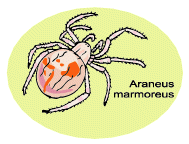
When you feel comfortable with this, the next stage is to watch a film or a video (perhaps a nature program) with spiders in.

You could, perhaps arrange a trip to a natural history museum where stationery spiders are on display and progress to a wildlife centre where you can watch spiders (under glass), as they move about.

The next stage has to be the imaginary scene where you relax and think about a spider harmlessly scuttling around. When you are comfortable about this you can imagine picking one up or placing a glass over the spider and sliding a piece of card underneath it to rescue it and place it in a safe place outdoors.

As you progress you will finally expose yourself to a spider (by expose, I don’t mean that you’ll strip off, of course) – and will be able to pick one up, using either of the imagined methods you’ve previously visualized.

Adapting the Method

The same principle would apply to someone suffering from, for example, a fear of flying or a fear of heights.

You could begin by looking at photographs or pictures of airplanes or a view from a very high building and gradually progress to watching a film of the same object or situation to imagining flying on an airplane or being in a tall building or on a long flight of steps or an escalator (whatever the worst scenario was).

Note: Desensitization when used in conjunction with psychological treatment doesn’t usually involve exposing oneself to the phobic stimuli in one session – it can take place over a number of weeks or even months.

Flooding

As the name suggests, flooding means being subjected the maximum exposure of the phobic stimuli in order to produce the conditioned response and dissipate any fear. This could be carried out with someone who had a fear of crowds, for example. They may be accompanied by a ‘helper’ who would stay at a comfortable to reassure the sufferer if need be.

Once it was realized that nothing awful was going to happen the fear should subside and the sufferer realizes that the fear is groundless. Likewise, our fear of spiders subject could be given maximum exposure to a roomful of jour eight legged friends until she realizes that she is safe and in control of the situation.

NLP

Practitioners of NLP use specific language patterns that communicate unconsciously to the subject. One of their main tenets of thought is that no-one is broken – we all have the internal resources to help ourselves.


A Fast Phobic Release program might involve the subject being asked to imagine the spider as looking quite ridiculous, for example, wearing a big hat and sunglasses, hobbling around on one leg and holding onto the rest, or carrying crutches. This method brings humour into the situation and helps to release the fear.

Another method might be to have the victim imagine the spider on a screen and turn down the brightness, size and intensity of the image, have it float up into the corner of the screen and project a more positive image into the centre. They would then use a ‘swish’ technique to replace any further images of spiders to the more desired one.


Hypnosis


Hypnotherapists use different approaches to eliminating phobic responses. One method, known as Suggestion Therapy would be similar to the NLP method, by hypnotizing the subject into a relaxed state and offering suggestions to the subconscious mind that they are totally comfortable in whatever the phobic situation is.

For example, someone with a fear of flying could be directed to find a ‘safe place’ before embarking on a flight. Knowing they can return to this safe place at any time, they would be taken on an imaginary journey, commencing with purchasing the tickets for a holiday abroad, imagining themselves at home preparing for the journey, arriving at the airport, embarking the plane and eventually flying and feeling comfortable about it.


If at any time, an signs of anxiety were apparent, the subject can be taken back to the safe place.

Regression

This method aims to remove the original cause of the anxiety by taking the subject back to when the anxiety was initially felt.

One method is to use an ‘Affect Bridge’ whereby the subject is instructed to remember the last time she experienced such fear and trace it back the initial event. Another method would involve setting up signals with subject’s subconscious mind and asking questions about when the fear was first experienced, taking them back to that original event and reframing it or reassuring the subject.


Example


An elderly lady had been afraid of flying for most of her life. Questioning her subconscious mind during hypnosis, revealed that this was not entirely her own fear, but had begun when she saw a photograph of her father, who himself suffered from a fear of flying, having a panic attack on an airplane. This had affected her so much that she ‘inherited’ her father’s fear and made it her own. It was not until, many years later, when this lady was able to see cause of her fear, she was able to release it.


Self Hypnosis and Affirmations


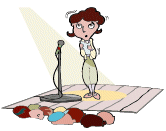
The easiest way to learn self hypnosis is to be hypnotized and receive a post hypnotic suggestion that you will be able to enter the hypnotic state at a given signal. This involves going into a trance state and giving yourself affirmations in the present tense, for example – I feel comfortable in the presence of strangers, I remain calm and relaxed whenever I see a spider, and so on.


The Affirmation can itself be turned into a symbol which the subject focuses on whilst inducing self hypnosis. This method involves creating a nonsense symbol (something he or she will not consciously recognize), perhaps made through writing a sentence on the desired outcome and eliminating all repeated letters and vowels, then combining them into an image of sorts. Because the symbol is illogical the subconscious mind can accept the meaning behind it without interference from the conscious, thinking mind.
Posted in Anxiety | Leave a comment

A Guide to Overcoming Phobias: The Symptoms

Physical Symptoms

Symptoms that appear physiological often develop out of the unexplored anxieties and can range from stomach ulcers, migraines, irritable bowel syndrome, rashes, to stuttering, blushing, warts, impaired memory, palpitations – the list is endless.


If a persona suffering from a stomach ulcer was taken into hospital and operated upon, their stomach ulcer might disappear and they would be proclaimed as fit and healthy again. However, if that menacing, free-floating anxiety was still lying dormant within the person’s subconscious mind, chances are that they would later develop a different symptom. The mind carries it’s memory traces and patterns and these are likely to be repeated if the cause of the anxiety or phobia is not revealed and dealt with.


Anxiety and Panic Attacks


A person who is confronted with the symbolic situation or object of his phobia could suffer a variety of symptoms depending on the degree of anxiety felt. The most common ones are: palpitations, sweaty hands or back of the neck, racing heart, pounding head, tremors, breathlessness, fainting, constricted muscles, light-headedness and shaking – quite often the person suffering the attack feels rooted to the spot.


The first time an anxiety attack is experienced it usually seems to happen for no apparent reason, therefore, the subject cannot rationally explain it to himself ad it is literally a ‘fear of the unknown’.


Once the panic attack is over, the subject returns to normal, realizing that no harm has really been done. However, because it cannot be satisfactorily explained, the sufferer never knows when it is going to recur – it has been likened to living next door to a volcano – that could erupt at any time.


In fact the victim of the panic attack is subsequently watching and waiting for the next onset, so much so that, when it does happen again, it erupts with a vengeance, increasing the level of anxiety to an alarming degree. This leads to a ‘vicious cycle’ of the mind affecting the body and the body counteracting by affecting the mind’ until the whole pent up emotion is discharged and the energy dissipated.


Posted in Anxiety | Leave a comment

A Guide to Overcoming Phobias

Experienced hypnotherapist Faith Waude DHP has treated thousands of people for issues such as fears and phobias. Writing exclusively for Psychologist World, Faith takes us through the psychological techniques you can employ to self-help yourself to overcome those fears forever…

First, to define a phobia…

There are literally thousands of different kinds of phobia; practically all of them have been given names, ranging from Agoraphobia (fear of open spaces) to Xenophobia. (Fear of strangers or foreigners), it would take a whole volume to even attempt to list them all.

A Roman writer named Celsius first used the word phobia to describe ‘morbid fears’ and since then that name has stuck, even being used by William Shakespeare.

Many people have phobias without even realizing it – people who blush furiously when facing a situation where they feel they are being looked at, probably have no idea that they are suffering from scopophobia (a fear of being stared at) whilst another person who is actually afraid of blushing could be said to have ereuthophobia (a fear of blushing).

Queen Elizabeth I had a fear of having a rose anywhere near her, but it is doubtful that she’d ever heard of the term anthophobia and King Edward VII’s fear of the number thirteen affected him so much that he could not bear to be at a table where there were thirteen people present.

Although each phobia is given a different name and all seem unique to the person suffering this extreme fear, they are actually a symbolic outward expression of internal anxiety – a free floating, nameless, formless thing that is within themselves but outside of their own control.

This free floating anxiety attaches itself to something within the individual’s environment in order for them to make sense of it. It is far easier to attach an anxiety to, for example, a fear of spiders, than it is to try to understand what these internal conflicts represent and to then deal with them. In a way, phobias are more common in intelligent people as it takes a degree of intellect for a person to project these free floating anxieties outside him or herself.

The gain to the intellect is that it is far easier to project these unwanted feelings onto something that they can understand and so avoid, rather than try to work out what it is that is causing the anxiety.

Should the sufferer avoid whatever it is that represents his phobia (e.g. thunderstorms) and still feel bouts of anxiety, then his phobia will escalate at an alarming rate and he or she could develop numerous other fears and phobias, such as fear of electricity, fear of sudden, loud noises, fear of leaving the home, etc. until he or she has a long list of phobias.


Posted in News & updates | Leave a comment

Personality Type Test Link

Psychoanalyst Sigmund Freud theorised that our personality development is based on childhood events and labelled personality types such as analy retentive and oral. Find out your personality type by answering these questions:

Find out if you’re fixated at one of Freud’s stages – take the test…
(Complete report available on subscription)

Select the most appropriate answer for each of the following stages. Be honest in your answers, as this will improve the accuracy of the report (requires registration).

https://www.psychologistworld.com/influence_personality/test1.php

Posted in Coping mechanisms | Leave a comment

Treating Anxiety Disorders The Behavioral Approach

Psychotherapy involves talking with a trained mental health professional, such as a psychiatrist, psychologist, social worker, or counselor to learn how to deal with problems like anxiety disorders.

Cognitive-Behavioral and Behavioral Therapy

Research has shown that a form of psychotherapy that is effective for several anxiety disorders, particularly panic disorder and social phobia, is cognitive-behavioral therapy (CBT). It has two components. The cognitive component helps people change thinking patterns that keep them from overcoming their fears. For example, a person with panic disorder might be helped to see that his or her panic attacks are not really heart attacks as previously feared; the tendency to put the worst possible interpretation on physical symptoms can be overcome. Similarly, a person with social phobia might be helped to overcome the belief that others are continually watching and harshly judging him or her.


The behavioral component of CBT seeks to change people’s reactions to anxiety-provoking situations. A key element of this component is exposure, in which people confront the things they fear. An example would be a treatment approach called exposure and response prevention for people with OCD. If the person has a fear of dirt and germs, the therapist may encourage them to dirty their hands, then go a certain period of time without washing. The therapist helps the patient to cope with the resultant anxiety. Eventually, after this exercise has been repeated a number of times, anxiety will diminish. In another sort of exposure exercise, a person with social phobia may be encouraged to spend time in feared social situations without giving in to the temptation to flee. In some cases the individual with social phobia will be asked to deliberately make what appear to be slight social blunders and observe other people’s reactions; if they are not as harsh as expected, the person’s social anxiety may begin to fade. For a person with PTSD, exposure might consist of recalling the traumatic event in detail, as if in slow motion, and in effect re-experiencing it in a safe situation. If this is done carefully, with support from the therapist, it may be possible to defuse the anxiety associated with the memories. Another behavioral technique is to teach the patient deep breathing as an aid to relaxation and anxiety management.


Behavioral therapy alone, without a strong cognitive component, has long been used effectively to treat specific phobias. Here also, therapy involves exposure. The person is gradually exposed to the object or situation that is feared. At first, the exposure may be only through pictures or audiotapes. Later, if possible, the person actually confronts the feared object or situation. Often the therapist will accompany him or her to provide support and guidance.


If you undergo CBT or behavioral therapy, exposure will be carried out only when you are ready; it will be done gradually and only with your permission. You will work with the therapist to determine how much you can handle and at what pace you can proceed.


A major aim of CBT and behavioral therapy is to reduce anxiety by eliminating beliefs or behaviors that help to maintain the anxiety disorder. For example, avoidance of a feared object or situation prevents a person from learning that it is harmless. Similarly, performance of compulsive rituals in OCD gives some relief from anxiety and prevents the person from testing rational thoughts about danger, contamination, etc.


To be effective, CBT or behavioral therapy must be directed at the person’s specific anxieties. An approach that is effective for a person with a specific phobia about dogs is not going to help a person with OCD who has intrusive thoughts of harming loved ones. Even for a single disorder, such as OCD, it is necessary to tailor the therapy to the person’s particular concerns. CBT and behavioral therapy have no adverse side effects other than the temporary discomfort of increased anxiety, but the therapist must be well trained in the techniques of the treatment in order for it to work as desired. During treatment, the therapist probably will assign “homework”�specific problems that the patient will need to work on between sessions.

CBT or behavioral therapy generally lasts about 12 weeks. It may be conducted in a group, provided the people in the group have sufficiently similar problems. Group therapy is particularly effective for people with social phobia. There is some evidence that, after treatment is terminated, the beneficial effects of CBT last longer than those of medications for people with panic disorder; the same may be true for OCD, PTSD, and social phobia.


Medication may be combined with psychotherapy, and for many people this is the best approach to treatment. As stated earlier, it is important to give any treatment a fair trial. And if one approach doesn’t work, the odds are that another one will, so don’t give up.


If you have recovered from an anxiety disorder, and at a later date it recurs, don’t consider yourself a “treatment failure.” Recurrences can be treated effectively, just like an initial episode. In fact, the skills you learned in dealing with the initial episode can be helpful in coping with a setback.


Posted in Coping mechanisms | Leave a comment

Tap Into Your Personal Power Positive Affirmations

Present Tense Affirmations
I am directly tapped into my personal power
I have full command of my personal power
I am in tune with my personal power and in full control of it
I am naturally able to command my personal power and I am successful because of this
I always act in the moment and get things done as they need doing
I am a natural action taker
I act on my desires immediately and without hesitation
I can achieve anything I set my mind to
I am motivated and driven and I always follow through on my goals and plans
I believe in myself 100% and I can achieve the lifestyle I desire


Future Tense Affirmations
I am becoming more in touch with my personal power every single day
I will take control of my personal power
I am finding myself more driven, ambitious and focused on my goals
I am turning into someone who is naturally motivated, ambitious and focused on creating success
I am becoming a natural action taker
I will always act on my desires and motivations
I will act in the moment, without hesitation, every single time
I am turning into a focused, productive, action orientated individual
I am starting to see success and positive improvement from taking control of my mind
I am starting to live my dream reality and moving towards it every single day


Natural Affirmations
My personal power comes naturally to me
I find it easy to tap into my personal power
Being in full command of my mind and body comes naturally and effortlessly
Being successful is my natural rite
Success is something I just achieve naturally through following my desires and taking action
Taking action upon my desires is my natural way of life
My personal power to act, live in the moment and follow my dreams is my greatest asset
People see me as someone who takes action and works all out to achieve their dreams
People look up to me as a driven, ambitious and successful person
Taking action as soon as I have the instinct to is the reason for my success
Posted in Affirmations | Leave a comment

Treating Anxiety Disorders The Pharmocological Approach Medications

Psychiatrists or other physicians can prescribe medications for anxiety disorders. These doctors often work closely with psychologists, social workers, or counselors who provide psychotherapy. Although medications won’t cure an anxiety disorder, they can keep the symptoms under control and enable you to lead a normal, fulfilling life.

The major classes of medications used for various anxiety disorders are described below.


Antidepressants

A number of medications that were originally approved for treatment of depression have been found to be effective for anxiety disorders. If your doctor prescribes an antidepressant, you will need to take it for several weeks before symptoms start to fade. So it is important not to get discouraged and stop taking these medications before they’ve had a chance to work.


Some of the newest antidepressants are called selective serotonin reuptake inhibitors, or SSRIs. These medications act in the brain on a chemical messenger called serotonin. SSRIs tend to have fewer side effects than older antidepressants. People do sometimes report feeling slightly nauseated or jittery when they first start taking SSRIs, but that usually disappears with time. Some people also experience sexual dysfunction when taking some of these medications. An adjustment in dosage or a switch to another SSRI will usually correct bothersome problems. It is important to discuss side effects with your doctor so that he or she will know when there is a need for a change in medication.


Fluoxetine, sertraline, fluvoxamine, paroxetine, and citalopram are among the SSRIs commonly prescribed for panic disorder, OCD, PTSD, and social phobia. SSRIs are often used to treat people who have panic disorder in combination with OCD, social phobia, or depression. Venlafaxine, a drug closely related to the SSRIs, is useful for treating GAD. Other newer antidepressants are under study in anxiety disorders, although one, bupropion, does not appear effective for these conditions. These medications are started at a low dose and gradually increased until they reach a therapeutic level.


Similarly, antidepressant medications called tricyclics are started at low doses and gradually increased. Tricyclics have been around longer than SSRIs and have been more widely studied for treating anxiety disorders. For anxiety disorders other than OCD, they are as effective as the SSRIs, but many physicians and patients prefer the newer drugs because the tricyclics sometimes cause dizziness, drowsiness, dry mouth, and weight gain. When these problems persist or are bothersome, a change in dosage or a switch in medications may be needed.

Tricyclics are useful in treating people with co-occurring anxiety disorders and depression. Clomipramine, the only antidepressant in its class prescribed for OCD, and imipramine, prescribed for panic disorder and GAD, are examples of tricyclics.


Monoamine oxidase inhibitors, or MAOIs, are the oldest class of antidepressant medications. The most commonly prescribed MAOI is phenelzine, which is helpful for people with panic disorder and social phobia. Tranylcypromine and isoprocarboxazid are also used to treat anxiety disorders. People who take MAOIs are put on a restrictive diet because these medications can interact with some foods and beverages, including cheese and red wine, which contain a chemical called tyramine. MAOIs also interact with some other medications, including SSRIs. Interactions between MAOIs and other substances can cause dangerous elevations in blood pressure or other potentially life-threatening reactions.

Anti-Anxiety Medications
High-potency benzodiazepines relieve symptoms quickly and have few side effects, although drowsiness can be a problem. Because people can develop a tolerance to them�and would have to continue increasing the dosage to get the same effect�benzodiazepines are generally prescribed for short periods of time. One exception is panic disorder, for which they may be used for 6 months to a year. People who have had problems with drug or alcohol abuse are not usually good candidates for these medications because they may become dependent on them.

Some people experience withdrawal symptoms when they stop taking benzodiazepines, although reducing the dosage gradually can diminish those symptoms. In certain instances, the symptoms of anxiety can rebound after these medications are stopped. Potential problems with benzodiazepines have led some physicians to shy away from using them, or to use them in inadequate doses, even when they are of potential benefit to the patient.


Benzodiazepines include clonazepam, which is used for social phobia and GAD; alprazolam, which is helpful for panic disorder and GAD; and lorazepam, which is also useful for panic disorder.

Buspirone, a member of a class of drugs called azipirones, is a newer anti-anxiety medication that is used to treat GAD. Possible side effects include dizziness, headaches, and nausea. Unlike the benzodiazepines, buspirone must be taken consistently for at least two weeks to achieve an anti-anxiety effect.


Other Medications

Beta-blockers, such as propanolol, are often used to treat heart conditions but have also been found to be helpful in certain anxiety disorders, particularly in social phobia. When a feared situation, such as giving an oral presentation, can be predicted in advance, your doctor may prescribe a beta-blocker that can be taken to keep your heart from pounding, your hands from shaking, and other physical symptoms from developing.

Adapted from http://www.nimh.nih.gov/publicat/anxiety.cfm

Posted in Anxiety, News & updates | Leave a comment

What is OCD?

Obsessive-compulsive disorder (or OCD), as categorized by the DSM-IV, is an anxiety disorder. It is characterised by the obsessive need to perform some task. These tasks are often known as rituals. Note that the DSM-IV Axis II Obsessive-compulsive personality disorder is considerably different from Obsessive-compulsive disorder, and is often what people mean when they refer to somebody as “obsessive-compulsive”.
Today it is well-accepted that OCD is much more common than was thought previously. Typically 2�3 % of the general population is believed to have OCD or OCD-like symptoms.


In many cases the task that an OCD sufferer does may seem simple to the layperson, but the sufferer feels that they must perform it in some particular way for fear of dire consequences. Examples might include checking that one has locked one’s car many times over before leaving it parked, or turning the lights on and off a set number of times every time one leaves a room. Such a person, when addicted to cigarettes, may argue that they can only quit smoking on the 13th or 27th of each month, and only when they possess four cigarettes at noon. Some people who have OCD may be completely aware that such obsessions are not rational, but feel bound to comply with them because otherwise they suffer from panic or irrational dread.


Obsessions are ideas that the person cannot stop thinking about. These are often fears about getting a disease, getting hurt, or causing harm to someone. The main features of obsessions are that they are automatic, frequent, upsetting or distressing, and difficult to control or get rid of. Compulsions refer to actions that the person performs, usually repeatedly, in an attempt to make the obsession go away. These are often cleansing or avoidance actions. Common compulsions include excessive washing and cleaning, checking, repetitive actions such as touching, counting, arranging and ordering, hoarding, ritualistic behaviours that lessen the chances of provoking an obsession. Compulsions can be observable actions, for example washing, but they can also be mental rituals such as, repeating words or phrases, counting, or saying a prayer.


Causes and related disorders

Recent research has revealed a possible genetic mutation that could be the cause of OCD. Researchers funded by the National Institutes of Health have found a mutation in the human serotonin transporter gene, hSERT, in unrelated families with OCD.


Violence is rare among OCD sufferers, but the disorder is often debilitating to the quality of life. Also, the psychological self-awareness of the irrationality of the disorder can be painful. For people with severe OCD, it may take several hours a day to carry out the compulsive acts. More often, they avoid certain situations or places altogether.


Some people with OCD also suffer from other conditions such as Tourette syndrome, attention deficit disorder, trichotillomania, hypochondria or Pure Obsessional OCD (rumination).

Treatment

OCD can be treated with a variety of anti-depressants, such as Anafranil, or selective serotonin reuptake inhibitors such as Paxil, Zoloft, Prozac, Luvox, and Anafranil. Some medications like Gabapentin have also been found to be useful in the treatement of OCD. Symptoms tend to return, however, once the drugs are discontinued. There are claims that long-term remission of symptoms has been achieved without medications through cognitive-behavioral therapy making use of the principles of extinction and habituation.


OCD: A Case History

Posted in News & updates | Leave a comment

Cognitive Approach in Psychology

The Cognitive Approach in psychology is a relatively modern approach to human behaviour that focuses on how we think, with the belief that such thought processes affect the way in which we behave (other approaches take other factors into account, such as the biological approach, which acknowledges the influences of genetics and chemical imbalances on our behaviour).


What it is and where the cognitive approach came from
  1. Stimulus (External Factor)
  2. affects:
  3. Response (Human Behavior)

There is some dispute as to who created the cognitive approach, but some sources attribute the term to the 1950s and 1960s, with Ulric Neisser’s book Cognitive Psychology, which made allusions of the human mind working in a similar fashion to computers. The approach came about in part due to the dissatisfaction with the behavioural approach, which focused on our visible behaviour without understanding the internal processes that create it. The approach is based on the principle that our behaviour is generated by a series of stimuli and responses to these by thought processes.

Comparison to other approaches

Cognitive (meaning “knowing”) psychologists attempt to create rules and explanations of human behavior and eventually generalise them to everyone’s behaviour. The Humanistic Approach opposes this, taking into account individual differences that make us each behave differently. The cognitive approach attempts to apply a scientific approach to human behaviour, which is reductionist in that it doesn’t necessarily take into account such differences. However, popular case studies of individual behaviour such as HM have lead cognitive psychology to take into account ideosynchracies of our behaviour. On the other hand, cognitive psychology acknowledges the thought process that goes into our behaviour, and the different moods that we experience that can impact on the way we respond to circumstances.

Key Assumptions
  • Human behaviour can be explained as a set of scientific processes.
  • Our behaviour can be explained as a series of responses to external stimuli.
  • Behaviour is controlled by our own thought processes, as opposed to genetic factors.


Evaluation of the Cognitive Approach
A viable approach which has been used to create the multi-store model of memory processes, supported by many other experiments.
Easily combined with other approaches. Cognitive-Behavioural Therapy is a popular and successful form of treatment for issues such as obsessive compulsive disorder.
Takes into account the internal, invisible thought processes that affect our behaviour, unlike the behavioural approach.
Depends largely on controlled experiments to observe human behaviour, which may lack ecological validity (being compared to real-life behaviour).
Does not take into account genetic factors; for example hereditary correlations of mental disorders.
Reductionist to an extent, although case studies are taken into account, the behavioural approach attempts to apply the scientific view to human behaviour, which may be argued to be unique to each individual.
Posted in News & updates | Leave a comment

Top Ten Tips for the Best Year of Your Life

We typically think of New Year’s as the time to make annual resolutions and start fresh. Unfortunately, we all know that most resolutions are quickly forgotten. The good new is that “now” is always the best time to take charge of your future and create the life you want. Real success is about choosing your priorities, and then following a plan that emphasizes the things that are most important to you. With that in mind, here are 10 suggestions for creating a wonderful, productive and rewarding year for yourself (and your practice)!

1. Take time to decide what you really want this year. What would make it a great year, a fantastic year for you? Dream and scheme, and then dream bigger! And write it down, just for the fun of it.

2. Mark one day each month, just for you. Use ink, not pencil, and schedule an appointment with yourself for one full day each month. Have fun and renew yourself, just for the joy of it. Every single month. No exceptions.

3. Take more vacation that you had planned. Look at the calendar and write in a couple extra weeks off! Relax. Do things you enjoy. Go camping, rent a cabin at the beach, visit old friends, or climb a mountain. Just do it!

4. Commit to a project you’ve dreamed of but haven’t done. This is not a “should” or a “have to”. It’s an “I’ve always wanted to but never did” project. Learn to ski, write a book, visit Niagara Falls, start a business, or run for mayor. This is the time!

5. Buy four books you’ve always wanted to read, and schedule time for them. Put it in your appointment calendar as “continuing education” or “research”, and enjoy!

6. Donate time each week to a cause or group that needs your help. Mentor a child, support the Red Cross, volunteer at your house of worship. Make a difference.

7. Renew relationships with family and friends. Every week, send a note or make a call, and re-connect with the people who have helped you along the way.

8. Make a point every single day to tell someone you appreciate them, that you are grateful for their help. Practice the attitude of gratitude!

9. Raise your sites and increase your goals. Double what you expect of yourself and your world, then commit to making it happen! Expect great things.

10. Be kind to yourself and those around you. Be gentle, practice patience, expect the best and settle for nothing less.

That’s it for this week. Is it Barbra Streisand who says, “Be good to yourself, and to someone else”? Have a wonderful week!

© Copyright 2003 by Philip E. Humbert. All Rights Reserved.


Posted in News & updates | Leave a comment
