
Americans View Mental Health and Physical Health as Equally Important

As we focus attention on mental health and suicide during National Suicide Prevention Week, Sept. 7 – 13, a new national survey about mental health and suicide provides some insight on Americans’ understanding and perceptions.

According to the survey, U.S. adults recognize the importance of mental health care to overall health, but don’t feel the current health care system matches that need. The overwhelming majority of adults (89 percent) feel that mental health and physical health are equally important and feel that health services that address mental health, such as treatment for depression and suicide prevention, should be part of any basic health care plan (92 percent). However, less than one-third (28 percent) feel that mental and physical health are treated equally in our current health care system.

Survey Results
89%

of adults feel that mental health and physical health are equally important

55%

of adults say they know someone who has talked about/attempted/died by suicide

40%

of adults feel suicide can be prevented always/often

For more on the survey visit American Foundation for Suicide Prevention

The online survey was conducted in August for the Anxiety and Depression Associations of America, the American Foundation for Suicide Prevention and the National Alliance for Suicide Prevention.

Suicide has touched the lives of most adults — more than half (55 percent) of adults say they know someone who has talked about/attempted/died by suicide. Nearly three quarters of adults (74 percent) feel that most people who die by suicide show some signs before, and more than 40 percent feel it can be prevented always/often. Yet only a quarter (26 percent) think they could tell if someone is suicidal.

Americans are savvier than ever about the need for access to mental health care and its pivotal role in preventing suicide. As important is the fact that addressing mental health problems also improves outcomes for physical conditions as people become better able to take care of themselves.”Maria Oquendo, M.D., APA President-elect

Stigma of mental illness and suicide still plays a big role in people not seeking treatment. When it comes to seeking treatment, the survey found age made a difference. Younger adults ages 18-34 are more likely to consider it a sign of strength to see a mental health professional, compared with older adults, and also more likely to believe that suicide can always or often be prevented. Adults ages 54 and younger are more likely to have received treatment for a mental health condition than those 55 and older.

The survey also addressed peoples’ understanding of potential risk factors for suicide. The top two categories, each identified by 86 percent of adults, were mental health conditions (including depression PTSD and bipolar disorder) and life situations (including feeling hopeless, being bullied, financial problems, relationship problems, losing a job and going through a divorce). Drug and alcohol use and chronic condition/pain were each identified by about two-thirds of adults while less than half (47 percent) identified anxiety/panic disorder as a risk factor for suicide.
Posted in News & updates | Leave a comment

New Research Aims to Help Prevent Suicides

Despite many efforts and much progress, suicide continues to be a major issue across the country. Both the total number and the rate of suicides increased every year from 2005 to 2013, according to the Centers for Disease Control and Prevention. On average, a person dies by suicide every 15 minutes in the United States.

Some recent research shows promise in helping to prevent the tragedy of suicide and reversing this upward trend. The Veterans Health Administration (VHA) is using electronic health records data to help identify people at high risk of suicide. Researchers used the large volume of data available through the VHA to develop a predictive model of suicide risk. The research, involving data on more than 3,000 suicides and more than a million control patients, is the result of a collaboration between the Department of Veterans Affairs (VA) and the National Institute of Mental Health. Because this analysis uses the kinds of data common to large health systems, this research and knowledge holds promise for helping to prevent suicides in other areas beyond the VA.

Suicidal behavior is preventable and controlling the psychiatric conditions associated with it, whether with medication or psychotherapy is key,” noted APA President-elect Maria Oquendo, M.D. “We also now have interventions that target the suicidal behavior itself and patients can develop coping strategies to deal with suicidal thoughts or impulses.”

New research from Johns Hopkins University (1) found that state laws making it harder to get handguns were associated with a reduction in suicide deaths. Moreover, it is now evident that suicidal behavior runs in families, and appears inherited independently from psychiatric disorders. (2) That is, it is not simply that psychiatric illness is familial and increases risk for suicide. For example, some families with depression have suicidal behavior amongst its members, while other families with depression do not.

Clearly public perception and lingering stigma of mental illness and suicide play a role and talking about suicidal behavior openly in affected families can help individuals and their relatives identify suicidal thoughts or urges as requiring medical intervention. Interestingly, a recent public survey asked American adults what they thought would help reduce the number of suicides.

Posted in News & updates | Leave a comment

Semicolon Becomes a Symbol of Hope

A growing movement is using the semicolon, and in particular a semicolon tattoo, as a symbol of hope for people with mental illness. The Project Semicolon website describes the meaning behind the symbol:

A semicolon represents a sentence the author could have ended, but chose not to. The sentence is your life and the author is you.”

It represents a choice to live on especially for those who may have considered ending their lives.

The project has inspired many people to tattoo or draw the symbol in creative ways to symbolize their own struggles or to honor or support loved ones who have struggled. The project encourages people to use social media to promote the message and continue the conversation, sharing pictures and stories of hope and strength to help end the stigma of mental illness and encourage those who are struggling feel safe and comfortable enough to reach out for help.

The movement has motivated many to share images of their tattoos and positive messages, such as:

  • You Matter.
  • Something will grow from all you are going through and it will be you.
  • So far you’ve survived 100% of your worst days. You’re doing great.
  • You are not alone and your story does not end here!
  • It’s okay to feel sad, anxious, afraid. Take a breath, refocus, reach out, but keep going.

Project Semicolon was founded Amy Bleuel, a Green Bay, Wisc., artist. She lost her father to suicide and initiated the project as a way to honor her father. “I wanted to tell my story to inspire others to tell their story. I wanted to start a conversation that can’t be stopped, a conversation about mental illness and suicide so we can address it,” Bleuel told USA TODAY Network in a recent interview.

While this initiative is one of many aimed at raising awareness, fostering hope and fighting the stigma of mental illness, its simple and powerful message and symbol seem to be resonating with many. The project’s Facebook page has more than 100,000 likes and it has nearly 20,000 followers on Instagram.

In 2014, 9.4 million adults aged 18 or older reported they had thought seriously about trying to kill themselves at any time during the past 12 months and more than one million attempted suicide, according to new data from the Substance Abuse and Mental Health Services Administration (SAMHSA).

A new resource is available to help people who have attempted suicide take their first steps toward healing and recovery. A Journey Toward Health and Hope: Your Handbook for Recovery after a Suicide Attempt was developed by SAMHSA and features firsthand experiences of individuals who have survived a suicide attempt and their supporters.

Posted in News & updates | Leave a comment

A Brief Mental Health Checkup

We often focus more on treating illnesses, both physical and mental, than on staying healthy. But the absence of mental illness does not necessarily mean good mental health.

What is mental health? According to the World Health Organization, mental health is “a state of well-being in which an individual realizes his or her own abilities, can cope with the normal stresses of life, can work productively and is able to make a contribution to his or her community.” As we observe Mental Illness Awareness Week this week it is a good opportunity for self-assessment with a brief mental health checkup.

A Brief Mental Health Checkup

While not exhaustive, this list provides a starting point to examine how you’re doing emotionally and mentally. If any of these items raise a concern, talk with your health care provider.

Concentration

Are you able to focus on the task at hand and get it done in a timely manner? Or, do you find yourself overrun with missed deadlines and undone chores? Poor concentration is a hallmark of ADHD, but it can also be a symptom of depression or anxiety.

Tuning In

One characteristic important to good mental health is knowing yourself (being self-aware). How “in touch” do you feel with yourself? Do you feel like you’re experiencing emotions and don’t know why? It’s not uncommon to get so busy that you don’t have time to process what is happening on an emotional level. However, taking time to process events and emotions by writing in a journal or talking with a friend can be important to good emotional health.

Avoidance

Do you feel like you’re avoiding yourself? It may seem like a funny question, but if you find yourself trying to keep from being alone, there could be something you are avoiding emotionally. Many people find feelings of anxiety or worry are intensified when they are alone, and so find ways to stay busy.

Mood

Do your moods feel pretty stable, or are you experiencing significant mood swings (highs or lows)? Are you crying more than usual? Feeling persistently depressed for two weeks or more could indicate clinical depression. Talk to your health care provider.

Energy

Do you feel that you have the energy to do the things you need and want to do? Fatigue can be a sign of depression, anxiety and other mental illnesses, but it can also be a symptom of many physical illnesses. If you find that you are feeling unusually fatigued, contact your doctor.

Sleep

How are you sleeping well at night? Do you wake rested? Poor sleep can often be a sign that there is something troubling you emotionally. When under stress or dealing with a more serious mental illness, many people have trouble falling asleep or wake frequently during the night.

Tension, Anxiety

Are you feeling tense and anxious all the time? Is it hard to unwind at the end of the day? We live in a fast-paced society that is frequently stressful. However, if you’re unable to take mental breaks and relax for a few moments, then your stress could be approaching dangerous levels. Relaxation is a skill that many of us have to learn and practice. There are many ways to help you relax such as meditation, yoga and progressive muscle relaxation.

Balance

Is there an appropriate balance between your home life and your work life? Are you getting in some “me-time,” including physical exercise and spiritual pursuits? Achieving perfect balance is probably not possible, but it’s worth striving for!

Adapted from a previous series of posts from by Gina Duncan, M.D.

Posted in News & updates | Leave a comment

New Resources to Help You Get Coverage for Mental Health Conditions

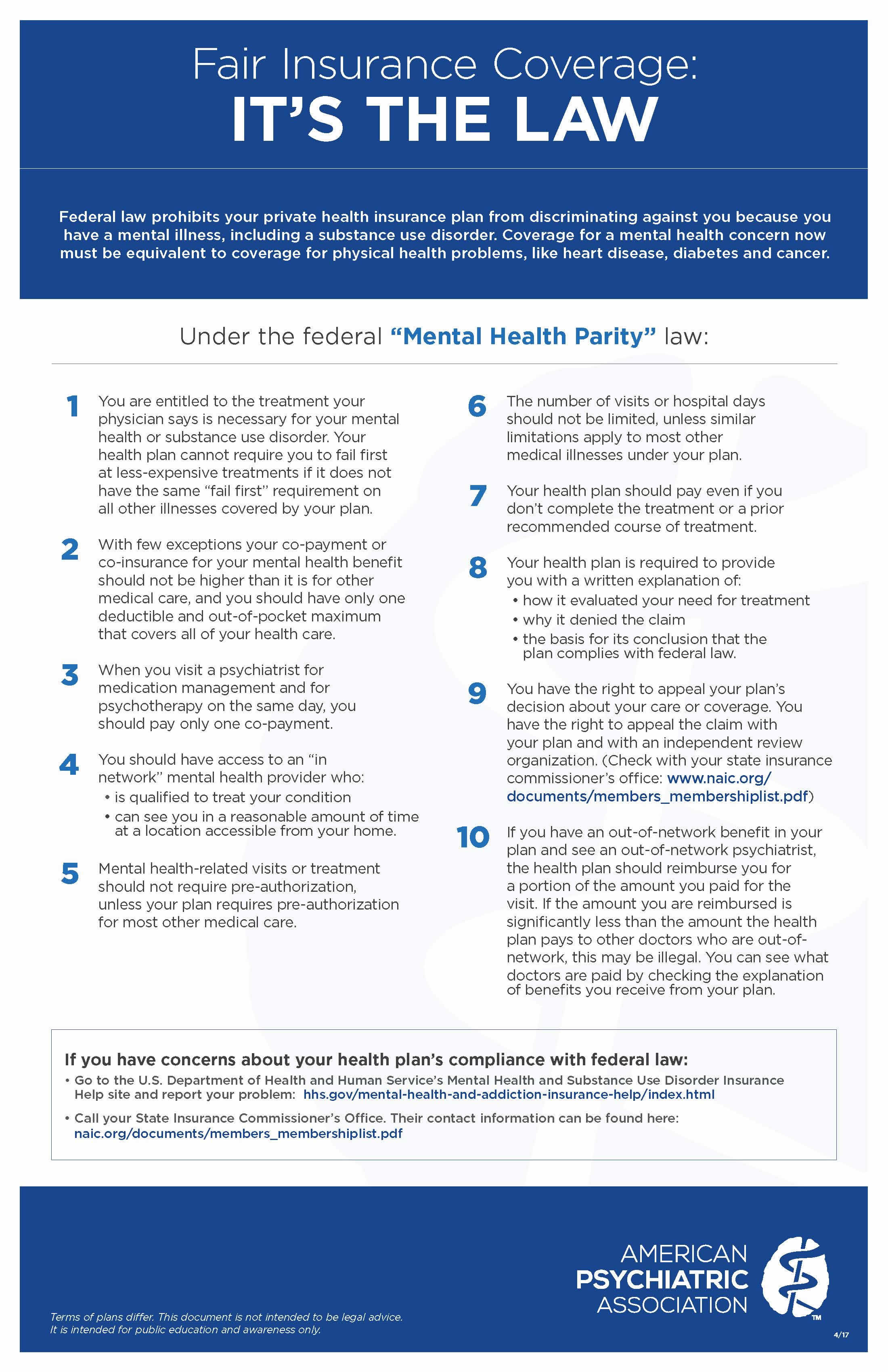
Recent federal laws have expanded health insurance coverage of mental health and substance use disorders, but accessing that coverage can be difficult and complicated. Many barriers still exist and challenges can vary from state to state. To enforce the law, federal and state agencies need to hear from you about possible violations. A number of new resources are available to help you understand your rights to coverage under the law and to get access to the coverage you deserve.

If you’ve been denied coverage, had limits set on behavioral health services, or are being charged more for behavioral health services than general medical services, that may be a violation of the law. But how do you know if it’s a violation and what can you do about it?

“How to File a Complaint” and Poster on the Law

Parity Poster
Click to enlarge

The American Psychiatric Association has developed a poster, Fair Insurance Coverage: It’s the Law (available in English and Spanish) that outlines the patient rights under federal law.

APA has also developed step-by-step guidance and template letters to help you file a complaint. Depending on the type of insurance you have, you will need to file a complaint with the U.S. Department of Health and Human Services, the U.S. Department of Labor, or your state insurance commissioner. See instructions on how to file a complaint.

Download the Mental Health Parity Poster

Parity Tracking Website

A new website, Parity Track, can also help you understand your rights under federal and state law. It provides simple explanations of common parity violations, such as “I have limits on how many times I can see a behavioral health provider” and “I am being charged more for prescription medication for behavioral health treatment than I am for prescription medication for other treatments.”

The site includes federal and state-by-state breakdown of parity legislation, regulations and litigation (see map below). It also has stories from across the country and highlights of some promising state initiatives. For example, new legislation in Missouri specifies how insurance plans should cover eating disorder treatment. New legislation in Maryland requires coverage of partial hospitalization for behavioral health treatment at the same terms as for other medical treatment.

Parity Resource Guide

A recently updated resource guide can help. The Parity Implementation Coalition* in conjunction with The Kennedy Forum recently published an updated version of the Parity Resource Guide for Addiction & Mental Health Consumers, Providers and Advocates, Simplifying the Appeals Process: Strategies for Winning Disputes with Your Health Plan.

The guide provides information for patients and families on the steps they can take to ensure they receive the same type of insurance coverage for mental health and substance use treatment as they receive for physical illnesses. It breaks down and simplifies the process and terminology, such as what a parity violation looks like and how an individual should initiate an appeal. It also explains medical necessity in regards to mental illness and the appeals process.

Parity Implementation: Legislation, Regulatory Action, Litigation from Parity Track

parity-map
map-key

*The Parity Implementation Coalition was formed to help ensure that the Mental Health Parity and Addiction Equity Act of 2008 (MHPAEA) is properly enforced and to end discrimination against individuals and families who seek services for mental health and substance use disorders. Members of the Coalition include the American Psychiatric Association, American Society of Addiction Medicine, Mental Health America, National Alliance on Mental Illness and others.

Posted in News & updates | Leave a comment

Warning Signs of Mental Illness

Major mental illnesses such as schizophrenia or bipolar disorder rarely appear “out of the blue.” Most often family, friends, teachers or individuals themselves begin to recognize small changes or a feeling that “something is not quite right” about their thinking, feelings or behavior before one of these illnesses appears in its full-blown form.

One half of all mental illness begins by age 14 and 75% begins by age 24.

Learning about developing symptoms, or early warning signs, and taking action can help. Early intervention can help reduce the severity of an illness. It may even be possible to delay or prevent a major mental illness altogether.

Signs and Symptoms

If several of the following are occurring, it may useful to follow up with a mental health professional.

  • Withdrawal — Recent social withdrawal and loss of interest in others
  • Drop in functioning — An unusual drop in functioning, at school, work or social activities, such as quitting sports, failing in school or difficulty performing familiar tasks
  • Problems thinking — Problems with concentration, memory or logical thought and speech that are hard to explain
  • Increased sensitivity — Heightened sensitivity to sights, sounds, smells or touch; avoidance of over-stimulating situations
  • Apathy — Loss of initiative or desire to participate in any activity
  • Feeling disconnected — A vague feeling of being disconnected from oneself or one’s surroundings; a sense of unreality
  • Illogical thinking — Unusual or exaggerated beliefs about personal powers to understand meanings or influence events; illogical or “magical” thinking typical of childhood in an adult
  • Nervousness — Fear or suspiciousness of others or a strong nervous feeling
  • Unusual behavior – Odd, uncharacteristic, peculiar behavior
  • Sleep or appetite changes — Dramatic sleep and appetite changes or decline in personal care
  • Mood changes — Rapid or dramatic shifts in feelings

One or two of these symptoms alone can’t predict a mental illness. But if a person is experiencing several at one time and the symptoms are causing serious problems in the ability to study, work or relate to others, he/she should be seen by a mental health professional. People with suicidal thoughts or intent, or thoughts of harming others, need immediate attention.

Taking Action, Getting Help

More than a decade of research around the world has shown that early intervention can often minimize or delay symptoms, prevent hospitalization and improve prognosis. Even if a person does not yet show clear signs of a diagnosable mental illness, these “red flag” early warning symptoms can be frightening and disruptive.

Encourage the person to:

  • Have an evaluation by a mental health or other health care professional.
  • Learn about mental illness, including signs and symptoms.
  • Receive supportive counseling about daily life and strategies for stress management.
  • Be monitored closely for conditions requiring more intensive care.

Each individual’s situation must be assessed carefully and treatment should be individualized. Comprehensive treatment to prevent early symptoms from progressing into serious illness can include ongoing individual and family counseling, vocational and educational support, participation in a multi-family problem-solving group, and medication when appropriate.

Family members are valued partners and should be involved whenever possible. Learning about mental illness and what is happening in the brain can help individuals and families understand the significance of symptoms, how an illness might develop and what can be done to help.

Just as with other medical illnesses, early intervention can make a crucial difference in preventing what could become a serious illness.

Posted in News & updates | Leave a comment

Psychiatrists and Psychologists: Understanding the Differences

People often confuse psychiatrists and psychologists. There are similarities—both psychiatrists and psychologists are trained to help people with mental health problems. But there are also important differences. If you need help with a mental health concern, who should you turn to, a psychiatrist or a psychologist?

Psychiatry is the branch of medicine focused on the diagnosis, treatment and prevention of mental, emotional and behavioral disorders. A psychiatrist is a medical doctor (M.D. or D.O.) who has completed medical school and residency. Psychiatrists also have special training in psychiatry and specialize in mental health, including substance use disorders. Psychiatrists are qualified to assess both the mental and physical aspects of psychological problems. A psychiatrist is able to conduct psychotherapy and prescribe medications and other medical treatments.

Because they are physicians, psychiatrists can order or perform a full range of medical laboratory and psychological tests. Psychiatrists’ education and training equips them to understand the complex relationship between emotional and other medical illnesses and relationships with genetics and family history, to evaluate medical and psychological data, to make a diagnosis, and to work with patients to develop treatment plans.

A psychologist has an advanced degree, usually a Ph.D. or Psy.D., most commonly in clinical psychology. Psychologists often have extensive training in research or clinical practice and in psychological testing and evaluation. Psychologists also complete a 1-2 year internship that gives them exposure to methods of treatment, analytical testing, problem-solving techniques and behavioral therapy. Psychologists treat mental health problems with psychotherapy and other behavioral interventions.

Among the key differences is that psychiatrists can prescribe medication and generally psychologists cannot. Psychiatrists’ training and practice is more grounded in biology and neurochemistry, whereas a psychologists’ training and practice is generally more focused on behavior. Mental health services provided by both psychiatrists and psychologists are typically covered by insurance. (See Mental Health Parity for more on insurance coverage of mental health services and the law.)

Some people, particularly those with more serious mental health concerns, work with both a psychiatrist and a psychologist as part of their health care team.

In addition to psychiatrists and psychologists, a number of other types of professionals provide various mental health services. Clinical social workers can help individuals and families with mental health problems most often through therapy, counseling, and advocacy. Licensed professional counselors, licensed marriage and family therapists, and certified pastoral counselors can also provide care for mental health concerns.

Primary care doctors are often the first ones people go to with mental health concerns. They often provide basic mental health services or work in consultation or collaboration with psychiatrists or other mental health professionals.

Posted in News & updates | Leave a comment

Providers, Patients have Differing Priorities when Looking at Treatment Options

A new study points to differences in priorities between patients and clinicians when deciding on treatment for depression.1 Patients and clinicians agreed on several top priorities when making a decision about how to treat depression: effectiveness of treatment, side effects, and speed of recovery. However, there were also several differences. Patients placed greater priority on treatment costs and insurance coverage. Providers placed higher priority on explanations of how a treatment should be used and how it works.

The survey, led by researchers from the Dartmouth School Institute of Health Policy and Clinical Practice, included nearly 1,000 U.S. adults who were being treated, were awaiting treatment, or had previously been treated for depression. Researchers also surveyed nearly 250 clinicians, including psychiatrists, primary care doctors, and therapists, who had recently treated patients for depression. Both patients and clinicians were asked to rate the information that they believed was most important when choosing a depression treatment.

The study authors note that while some may people contend that medical decision should be based solely on needs, the cost of treatment does have a direct impact. Costs can impact consumer well-being, financial stability, likelihood of sticking with treatment and, ultimately, health status and outcome.

Patients and providers expressed similar concerns related to side effects of treatment; however, patients included sleep problems and increased stress related to treatment among their high priorities.

The researchers also looked at the level of collaboration in decision making between patients and providers. Substantial previous research has found that shared decision making for people with depression leads to people sticking with treatment longer, being more satisfied with treatment, and having improved outcomes.2

Despite the benefits of shared decision making, a number of obstacles exist for patients and their physicians. 2 For example, patients may not see the need to participate or may feel the doctor should be making decisions and some mental health conditions may make it difficult to participate in decision-making. Physicians may feel they don’t have the time to devote to shared decision-making or may feel it is not appropriate in some critical situations.

To learn more about what you can do to improve your treatment for depression, see tips on Working with a Provider and Preparing for Appointments from Mental Health America. Also see more information on Shared Decision Making from the SAMHSA-HRSA Center for Integrated Health Solutions.

Posted in News & updates | Leave a comment

The Truth About Antidepressants

There are many misperceptions about mental illness and its treatment that contribute to stigma. People may incorrectly assume that the feelings that accompany anxiety anddepressive disorders can be willed away with the right amount of discipline, or that seeking help for them is a sign of weakness. It’s important to understand that these emotional disorders are not “normal” feelings. This fact is often misunderstood, which can also lead to misunderstandings about the use of medication.

Misinformation about the role that antidepressants or medication play in the treatment of mental illness can deter people with depression or anxiety from using what may be one of their best options for recovery. The term “antidepressant” is somewhat misleading, in that these medications could easily be called anti-anxiety medications and are used to treat many other conditions. Combined treatment, which involves drug therapy, psychotherapy and lifestyle change, has proved most effective in treating depression and anxiety and in lowering relapse rates.

Myth Truth
Antidepressants make you falsely happy. Antidepressants work gradually to normalize emotions.
Antidepressants keep you from feeling any emotions. The purpose of antidepressants is to get back to a fully functional work and personal life.
People should be able to deal with their depression and anxiety disorders naturally. Some people need help to regulate emotional problems, just like some people need inhalers to regulate their breathing or insulin to regulate blood sugar.
You’ll need to take medication for the rest of your life. Doctors try to be as conservative as possible when prescribing medication, recommending the smallest effective dose only for as long as is necessary.

Antidepressants Are Not “Happy Pills”

The purpose of antidepressants is to help a patient’s mood to return to a normal state, not to alter it. Antidepressants do not make you high or work quickly – they work over an extended period of time. These medications are not sedatives, “uppers” or tranquilizers. They are not habit-forming. Generally antidepressant medications have no stimulating effect on people not experiencing depression or anxiety. Most people start to feel better two to four weeks after starting treatment. Full benefits may not be felt for two to three months, or even longer in some patients.

The purpose of antidepressants is not to “make you happy,” nor are they intended to keep you from feeling emotions. The goal of medication and combined treatment is to help you get you back to functioning as your full self. Feeling emotionally numb is a symptom of depression, a symptom that the use of antidepressants is intended to help correct. If the medication is working correctly, a patient with a depressive or anxiety disorder should be able to experience typical levels of joy, sadness, stress and the full range of emotions.

There Is No Shame in Seeking Help

Mental illnesses are illnesses like any physical ailment – they often require combined treatment to improve. Sometimes treatment involves psychotherapy, sometimes it involves medication, and it requires both – along with lifestyle changes – to be most effective. If a person requires medication to manage a mood or anxiety disorder, it is important they do so, just as it is important for a person with asthma to use an inhaler or a person with diabetes to use insulin.

As with any medication, there can be side effects when using antidepressants. Some adverse effects, like sexual dysfunction, can be difficult to talk about, but it’s important to talk with your doctor and treatment team about how you’re reacting to your medication. Doctors weigh many factors in choosing an antidepressant, such as the person’s medical status, prior bouts of depression, prior responses to antidepressants and the presence of symptoms. There is a wide variety of treatment options for depression and anxiety, including a range of medications, and the right balance of medication, psychotherapy and lifestyle changes can differ from person to person.

If you are having trouble with what you think may be a mental health condition, it’s important to speak to your doctor. Early intervention can help reduce the severity of an illness. It may even be possible to delay or prevent a major mental illness altogether.

Posted in News & updates | Leave a comment

Understanding Mental Health Challenges with Online Simulations

We hear about people’s experiences with mental illness and we may see how someone behaves as a result of a mental health challenge, and we can empathize. But it’s hard to imagine experiences very different from the way we experience things – of hearing voices in your head, being extremely sensitive to or constantly distracted by sights and sounds, or not being able to read and learn the way most people can. While we can’t truly experience what someone else is going through, we can now go online to get a sense of some of these experiences through online simulations of mental health conditions.

Learning differences and attention issues

Understood.org has developed an extensive series of online simulations, called “Through Your Child’s Eyes,” of a range of learning and attention issues. They include reading, writing, attention and organizing. Understood.org is a collaboration of 15 nonprofits working to support parents of children with learning differences.

The website is designed to give parents and family members a better understanding of what a child with learning differences is experiencing. The site allows you to experience, for example, the frustration when your hand won’t write what your brain is telling it to, or how hard it is to read when you have to decode each word. A range of experiences are presented based on selections you make for a child’s age/grade level and the specific issue (reading, writing, attention, math or organization issues). In each case, you’ll see a short video from a child who has the learning or attention condition, and then you are given an interactive simulation to see how the particular challenge might feel. At the end, an expert provides information on the issue.

Another site provides a glimpse into dyslexia (reading disorder). Developer Victor Widell, created a computer simulation of the way a friend of his described experiencing dyslexia. While individuals’ experiences differ, this simulation gives an idea of the type of challenge faced by some with dyslexia.

Sensory overload

Sensory issues, both being overly sensitive or under-sensitive, are common among many people with autism spectrum disorder. The Interacting with Autism project has developed an animation that gives you a glimpse into the experience of sensory overloadand its impact in everyday life.

There are also several short videos of sensory overload experience at the Autism Speaks website. These depict sensory overload in different settings from different perspectives. One video compares a typical person’s experience walking down the street with the experience of someone with autism spectrum disorder who has increased sensitivity to light and sound. Another video highlights autism advocate Carly Fleischmann, who is non-verbal and on the autism spectrum. This video simulation shows Carly with her family in a crowded coffee shop and the anxiety she experiences.

Hearing voices

Some people with schizophrenia hear voices that are not real (called auditory hallucinations). You can hear a brief simulation of the experience of hearing voices online at the Empowerment Center. The sample is part of a complete training and curriculum package, Hearing Voices That Are Distressing, developed by Patricia Deegan, Ph.D., to train mental health professionals.

Postpartum depression

The National Coalition for Maternal Mental Health has developed a short video on What Postpartum Depression Feels Like, providing a brief glimpse into the thoughts and feelings of a new mom’s experience with the condition. (See recent post on Pregnancy and Depression.)

None of us can know exactly what another person experiences, but these simulations can help us understand and empathize with many mental health challenges.

Posted in News & updates | Leave a comment
